• Artist Profile: Sita Bhaumik

    Technology allows us to exchange pictures of our caloric intake with the rest of the world with a few clicks, swipes, and use of a snazzy filter. Specifically, in San Francisco, a cosmopolitan place brimming with an incredibly diverse population, it’s relatively easy to experience food from a seemingly vast array of cultures. Whatever you want, San Francisco probably has a place or a person that could lead your nose and taste buds to something that will satiate you. Art offers a very similar experience. With our collective compulsive nature to share photos of things we can’t even taste or smell speaks to our collective desire to be connected. While food nourishes us, it also activates our creativity. Cooking and eating is a way to let others into the particulars of what we allow into our bodies. What happens when food is used to describe the relationships we have with ourselves, our history, culture, or our ethnicity? What happens when food becomes the medium of an artwork? Or when it goes beyond the sense of sight and envelopes you in a completely multi-sensory experience? Food provides us with a lot of information about who and what we are. Think about an ornately covered wall dusted in nothing but curry. Imagine a room filled with the aromatic smell of cinnamon. Contemplate the use of ice cream and edible inkjet prints. This makes up only a fraction of the artwork created by Bay Area installation artist, Sita Bhaumik.

    As an artist, writer, and educator, Bhaumik does an extraordinary job at explaining the intricacies and constructs around weighty topics such as identity, culture, gender, and ethnicity, yet in such a whimsical, dynamic, and sometimes comical way. She manages to showcase her extreme wit and intelligence and makes history, cultural observations, and art digestible (pun intended). As a writer and scholar, Bhaumik re-invents the way in which we react to and contemplate food. She mentions in her writing, “Whether we’re in front of the television or at a museum, we arrive with tummies rumbling, ready to consume. On the one hand, food is a necessity. On the other, food is a luxury, trend, marketing opportunity, movement, and social-justice issue”. As much as food is a necessity, there are varying levels of accessibility and openness to scents and tastes that appear unfamiliar. Cumin, coriander, turmeric, garam masala, and chili powder on paper are only some of the ingredients Bhaumik uses to communicate something deeper about thought processes and perceptions of ourselves and others. Her work investigates and serves as a brilliant metaphor for the way in which we encounter someone outside of ourselves. Not only is her work elegant and meticulously done, it is an ingenious way to have people foster a different relationship with food as well.

    With the wide array of fusion foods and cuisines that make up the Bay Area, it certainly is a place for the creative intellectuals to whet the community’s appetite with innovative ways of seeing and experiencing art. Bhaumik’s workis certainly a testament to the creativity and the diverse art practices found in San Francisco. As we enter into the Fall months, Bhaumik already has her schedule filled with events and a residency! She will be participating on a Scholar’s panel entitled, Food in Focus: Asian and Latin American Cross-Cultural Cooking, for the Asian Culinary Forum. As the upcoming Bathroom Resident at 18 Reasons, Bhaumik’s inaugural show for the residency will open in October. Her work is certainly an experience. So, the next time you consider playing with your food, you want to think what Bhaumik may do given those same ingredients.

    To learn more about artist Sita Bhaumik, visit her website here

    Originally posted to Asterisk SF Magazine + Gallery site, please view here 

    ¶¶¶¶¶

    ¶¶¶¶¶

    ¶¶¶¶¶

    ¶¶¶¶¶

  • Curatorial Statement 

    Art serves as reflection. It mirrors what has come before, what exists, and gives inspiration to what may follow. Art is also a conduit to introspection. It raises questions about the relationship between culture, tradition, and location. In the exhibition, Querida Calle 24 | Dear 24th Street, installation artist Sita Kuratomi Bhaumik takes memories and experience to pay homage and gratitude to the well known 24th Street in San Francisco. With the increasing traffic and popularization of the Mission District, Bhaumik seizes the opportunity to form of a visual and a multisensory love letter to the stretch of urban landscape.

    The sweet smell of cinnamon leads the viewer to a patterned wall that will please even the most obvious retinal sense. Yet, the longer one stands and observes the walls dusted in the familiar spice and platters enrobed in gold candy wrappers, the senses will subtly shift back and forth to engage in something that can only be experienced. Observation will become delectable and crisp sensations will tickle the nose upon a deep inhale. Impressions will go beyond the gallery walls and storefront. The viewer will be greeted by a Twenty Fourth Street that refuses to be forgotten and remains ever present through its distinct scents and visuals. As a show made with a myriad of parts, it intricately meshes culture, tradition, and history into sensorial consumption. Bhaumik provides an exhibition of the past, present, and future. Our collective recollections and thoughts made into the tangible and the tasty, this artwork will waft and flirt and begs the senses to devour, digest, and reflect.

    ~ Yours Truly

    Artist Bio

    Sita Kuratomi Bhaumik is an interdisciplinary artist, educator, and writer born and raised in the suburbs of Los Angeles to Indian and Japanese Colombian parents. After receiving her B.A., Cum Laude, in Studio Art from Scripps College, Sita moved to the Bay Area where she holds an M.F.A. in Fine Art and an M.A. in Visual and Critical Studies from California College of the Arts. She currently teaches photography and portfolio development at RayKo Photo Center. Sita has collaborated with organizations such as Yerba Buena Center for the Arts, The Asian Art Museum of San Francisco, SOMArts, 18 Reasons, 826 Valencia, Whitman College, and Cal-State Fullerton. She has been the art features editor for Hyphen magazine, a writer for Art Practical, and Kearny Street Workshop board member. She also spends as much time as possible in the kitchen.

  • Creating strategies around how to deal with technology can become tiresome and futile. Technology is constantly at our fingertips for the majority of our days and, sometimes, nights. When we go to bed and wake up, virtuality and the Internet remain ubiquitously present. We may as well have our mobile devices tucked safely underneath our pillows for fear of being disconnected. If alien life forms were to descend, they may wonder how we obtain and retain our information. How do you describe looking into a backlit rectangular screen for approximately eight hours a day as a way to intellectually and emotionally digest images and contextualize your environment? From the world’s ugliest dog to the political and social upheaval in the Middle east to socializing online has become the way in which we obtain meaning about our environment. The anxiety and anticipation we feel to connect with others further adds to the way we function and re-create ourselves within language. In Christopher Baker’s work, Murmur Study, his installation showcases our collective meanderings through bringing physicality to our digital exchanges.

    As a 2012 ZERO1 biennial artist, Baker installed this iteration of Murmur Study in the back of the renovated and large exhibition space known as the ZERO1 Garage located in Downtown San Jose. The mottled, weathered, gray concrete that once served as a car repair shop now welcomes the footsteps of arts and technology patrons as well as curious newcomers. Baker reinvents micro messaging through circuitous wires and re-programmed thermal printers#. Far from reach, the printers are hung high on an exposed beam. Like soldiers at attention, they hold their post through the day and night without rest. Yet, the slow release of printed messages such as “That awkward moment when you’re eating fast food and some show about ‘how unhealthy the world is today’ is on tell…::whoops::?” provoke us to respond. Yet, the installation relies only on observation as the thin receipt paper cascade down and messages eventually reach eye level. On the gallery floor, the paper accumulates resulting in piles that resemble white discarded shoelaces. During the rush of opening night, bodies passed curiously by the work. As visitors passed the installation, the papers slightly billowed and reminded us of their presence.

    Baker’s interpretation of our digital life siphoned from social media platforms into tangible form showcase our methods of thinking and communicating. Our thoughts, once untouchable, fall into the form of computation and transmission. The papers serve as remnants of our processing and constructions of everyday life. The work addresses the theme of Seeking Silicon Valley in that much of what we might believe is created in this technological region actually encompasses so much more than the physical location. Murmur Study captures the hashtags of our collective desires and beliefs, sometimes humorous and poignant, other times offensive and didactic. It reminds us that Silicon Valley is rapidly becoming way more of an idea than a tangible place. As one continues to read the papers in Baker’s piece, its easy to notice the stream riddled with vernacular and awaiting interaction. Although rigid, sleek, and so far up from eye level, the viewer is still able to see the thick, tangled wiring and circuitry behind the neatly hung printers. We watch slowly as one the most familiar objects in consumption dispenses information and data on how we might spend our time.

    Originally posted to the ZERO1 blog here

    ¶¶¶¶¶

    ¶¶¶¶¶

    ¶¶¶¶¶

    ¶¶¶¶¶

  • The centuries-old tradition of building altars to welcome and celebrate deceased loved ones fuses with present-day artists’ sentiments on the state of life and politics in the Day of the Dead 2012 exhibition at SOMArts Cultural Center. Elaborate, traditional altars and multi-dimensional art installations are on display in Calling on the Spirits to Face the Future: Día de los Muertos 2012.

    The annual Day of the Dead exhibition provides a way for more than 80 participating artists and more than 4,000 exhibition visitors & 800 touring school children to embrace the beauty of life and to honor the spirits of the dead.

    Calling on the Spirits to Face the Future is dedicated to the late Daniel del Solar, a Chilean-American media activist, poet and photographer, and the late John Edward Buchanan, Jr., Director of the Fine Arts Museums of San Francisco.

    Click here to watch a video made at last year’s exhibition.

    Source Text: SOMArts Cultural Center

    ¶¶¶¶¶

    ¶¶¶¶¶

    ¶¶¶¶¶

    ¶¶¶¶¶

  • THE COMMONS CURATORIAL RESIDENCY PROGRAM ~ 2013–14 CALL FOR PROPOSALS

    SOMArts Cultural Center’s Commons Curatorial Residency Program contributes to the dynamic cultural ecosystem in the Bay Area by providing space and support for exhibitions that take creative risks, promote cultural connectivity and learning, and instigate accessible, multifaceted participation in the arts. Selected artists and groups receive support consisting of a $3,000 grant, a month-long exhibition in the SOMArts Main Gallery, 80+ hours of  technical assistance, and help with traditional and social media outreach to connect their work with new audiences.  Through this support, Bay Area artists can engage the community, expand their practice and turn vision into reality.

    SOMArts is requesting proposals for exhibitions in the Main Gallery for the 2013–14 season. This request is open to artists and independent curators presenting contemporary work in any medium.

    Please read through all documents, including the FAQ and eligibility guidelines, carefully. ALL LETTERS OF INTENT MUST BE RECEIVED VIA ONLINE SUBMISSION BY 11:59PM ON TUESDAY, OCTOBER 30, 2012. No late applications will be accepted, we strongly recommend submitting your proposal at least one week before the deadline.

    Source Text: SOMArts Cultural Center Website

    ¶¶¶¶¶

    ¶¶¶¶¶

    ¶¶¶¶¶

    ¶¶¶¶¶

  • New Catalogue + Judd Greenstein. This is a Present from a Small Distant World, 2012; installation view. Courtesy of the Scottsdale Museum of Contemporary Art, Scottsdale. Photo: Dorothy Santos.

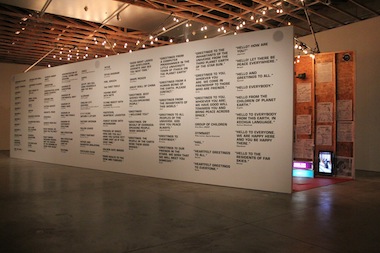
    The New Catalogue artist collective, composed of Mary Voorhees Meehan, Neil Donnelly, Jonathan Sadler, and Luke Batten, collaborated with composer Judd Greenstein to explore humanity, history, memory, space, and the unknown in their exhibition This is a Present from a Small Distant World: New Catalogue + Judd Greenstein, at the Scottsdale Museum of Contemporary Art. When viewers first enter the exhibition space, the large-scale installation is enclosed by two parallel white walls covered with friendly messages written in black bold sans serif type. Multicolored light boxes illuminate printed words such as “coffee,” “vinyl cutter,” “advice from a family member,” “string cheese,” and “twenty books.” These are only a small fraction of the humorous, endearing, and poignant answers to questions about communication with extraterrestrial beings.

    Walking through the red carpeted interior of the makeshift corridor, flat-screen monitors pose questions to the public. Classical music permeates the space. Between the exposed, unpainted, raw wooden beams, questions on newsprint paper invite viewers to participate in an analog discussion. Some of the questions include “What are ten things aliens would need to see/taste/touch/experience to understand life on earth?“; “Which five songs would you bring to space so alien life could understand us?”; and “What do you imagine aliens are like?” Answers to that last question included “Lady Gaga,” “Nikki Minaj,” and “Michael Jackson,” suggesting that some of the most colorful human beings in the public eye are the most foreign and otherworldly.

    These human observations ask us to consider what would happen if we could transmit and receive communication with alien life. Based on the posted responses, possibilities range from humankind’s greatest accomplishments in the arts and sciences to the sharing of radical and pointed views about our political and social state. The responses also speak to something deeper and more existential. New Catalogue and Greenstein have created a work that reminds viewers of the qualities philosophers and scientists have posited separate humans from other species: the ability to introspect, activate memory, and create awareness.

    Originally posted to Shotgun Reviews on Art Practical, please click here to view.

    ¶¶¶¶¶

    ¶¶¶¶¶

    ¶¶¶¶¶

    ¶¶¶¶¶

  • Noritaka Minami, A706 (Wall I), 2011; archival pigment print mounted on aluminum; 30 x 38 in. Courtesy of the Artist and the Kearny Street Workshop, San Francisco.

    Humans are resilient. Our anatomy is extraordinary and highly complex. We build, construct, destroy, and synthesize. But human nature involves understanding the biology and mechanisms that provoke us to move and accelerate. In Movement in Many Parts, an exhibition curated by Lucy Seena K. Lin and Weston Teruya, artists investigate human evolution through nature and industry. Their ruminations are shown through organic forms, moving image, photography, drawing, and painting. Each work reminds us of the adage that the totality of many things in concert is far greater than one single part of the whole.

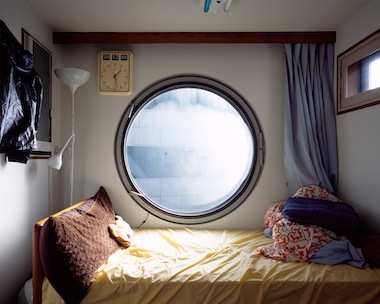
    In A1007 (Wall II) (2011), Noritaka Minami asks us to peer into the modular housing built within the Japanese urban landscape. At the start of the series, a viewer is let into a small room with a single, large round window that looks out onto the city and other pods. There is no returning gaze; a viewer sees only the disheveled room of a seemingly busy city dweller. The room could very well be a viewer’s; the window is the only way to see outside and to observe other living things. Stagnancy is apparent through the dull colors of bed sheets and the aging, disintegrating papers on the wall. Even the dated typography of the numbers on the clock suggests a thick layer of dust has settled over things untouched. The scene gives the sense that the busyness of city life has depleted the weary soul that inhabits this space. Minami’sTower (Facade 1) (2011) includes a segment of the exterior architecture that gives a viewer not only a sense of scale but also of how nature has weathered the building’s exterior. The erosion suggests that the original design is obsolete in this fast-paced environment.

    While Minami’s photographs depict an environment, Kim Anno’s photographs ponder the effects of climate change and demonstrate how humans may adapt to and work with rising sea levels. Men and Women in Water Cities (2011) shows individuals fully clothed in suits and corporate attire turning their bodies toward a viewer, as though caught in mid-action. The picture plane presents something absurd. Yet, is it as absurd as we think? Anno proposes peculiar but perhaps ingenious ways we might survive despite nature’s disposition, showing what humans may be driven to do when it is necessary to endure. It is this human tendency toward movement that forces resiliency.

    Originally posted to Shotgun Reviews on Art Practical, please click here to view.

    ¶¶¶¶¶

    ¶¶¶¶¶

    ¶¶¶¶¶

    ¶¶¶¶¶

  • Kate Lee Short. Oculus, 2012; salvaged speakers, speaker wire, Motu audio interface, Mac mini, Lepai Amplifiers, wood, 17 x14 x10 ft. Courtesey of SOMArts photo by J. Astra Brinkmann.

    You know what is awesome about grad school? Being around talented and brilliant artists and writers. Check out fellow classmate Erica Gomez’s guest blog post on the SOMArts Cultural Center blog regarding the Annual Murphy & Cadogan Contemporary Art Awards Group show. It’s a great write-up! Click here to view on SOMArts!

    Tristan Cai. Physical Realities of Death-A Memoir of Toivo Laukkannen, 2012; archival giclée prints on wood, 216 x120 in. Photo: Erica Gomez.

    The Annual Murphy & Cadogan Contemporary Art Awards Exhibition is on view at SOMArts through October 2, 2012.


  • This slideshow requires JavaScript.

    It’s been a few weeks since grad school started and I must say…I love it. The people, the discussions, the seminars, the reading (yes, even the ‘dry’ and ‘dense’ stuff) has been great. As challenging as it is to balance work with school and freelance obligations, I feel like I’ve had no other choice but to become extremely organized. Although there will be tough times ahead (I’ve already experienced a couple of late night study/writing sessions!), I have already grown significantly. My writing practice is shifting and taking such a different course. It’s all new territory for me but my brain is enjoying the cerebral nourishment. For anyone remotely interested in learning a bit more about the classes I’m taking, you can click here, here, and here. If you have any questions or want to share your thoughts, please feel free to leave a comment.

    I took a few pictures from our department dinner this past Friday. I had the opportunity to meet second and third year grads and spend some time with a few of my classmates. The Ramp was a great choice and drinks at dusk was such a great way to end the week. 🙂

    ¶¶¶¶¶

    ¶¶¶¶¶

    ¶¶¶¶¶

    ¶¶¶¶¶

    ¶¶¶¶¶

  • CCA Architecture Students
    I get to look at models (not the tall skinny kind)…

    I can’t believe it’s the first official day of school! I feel like a rambunctious kindergartener inside. My first class doesn’t start until noon so I’m checking in with professional and personal tasks and getting settled into my new surroundings. It’s a great feeling being here. One of the first things I did on campus was get the library sticker for my school ID. Since I wanted to ‘hit the ground running’ with research, the first question out of my mouth was, “Are we allowed to request books that are not in the library to be included in the collection?” The school librarian (and I’m sure one of my new BFFs) stated that the students are able to request books for purchase! Nice. Naturally, I wondered, “What is the budget for requests like that?”. In any case, I’m sure a portion of my tuition goes to this library so I better take good care of my resources.

    As I settle into my new space, I’m not going to lie, I’m nervous. Taking classes for personal enrichment is great and good. But going into a graduate program with the economy the way it is and learning adjunct professors don’t get paid squat, well, it’s a bit disheartening to say the least. Yet, I believe this is the right path for me despite what the naysayers think. Besides, I’m looking at an emerging field – new media and digital arts theory. Exciting stuff! Finding new friends, discovering artists, meeting scholars, and reading books (and more books) about this new territory is daunting but I know I’m in the right place.

    Bottom line: Having the support and the tools is great BUT it matters how you go about using them. It’s also about taking the onus for my success and failures and turning them around to make even bigger and better things (whether it’s writing, collaborative work, or helping build an organization). I will continue to use this space, primarily as a writing portfolio and sharing the exciting events happening at some of my favorite places (including ZERO1, GAFFTA, SOMArts Cultural Center, and Art Practical), which I will be sure to post. Also, with my recent trip to Phoenix, Arizona, pictures will be in the near foreseeable future (as soon as I can get them uploaded)!

    If you are curious about my academic life, check me out over here.

    ¶¶¶¶¶

    ¶¶¶¶¶

    ¶¶¶¶¶

    ¶¶¶¶¶