


Here are a few pictures I snagged from the #arthacksf event co-facilitated by The Creators Project and Gray Area Foundation for the Arts.
-
¶¶¶¶¶
¶¶¶¶¶
¶¶¶¶¶
¶¶¶¶¶
-
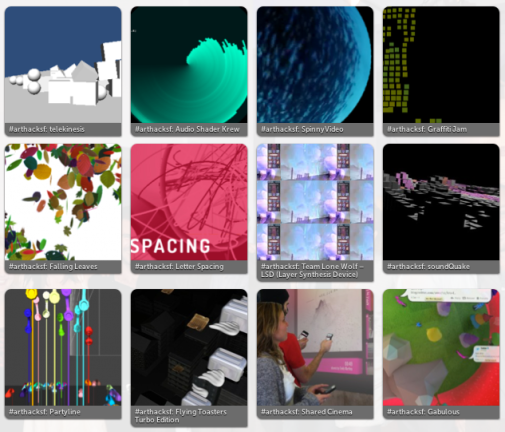
GAFFTA Hack Projects for #arthacksf | The Creators Project + GAFFTA Over the weekend, I volunteered at the Art Hack SF Weekend held at Gray Area Foundation for the Arts. There were artists, programmers, art directors, designers, musicians, and other creative types. How àpropos that Soundquake was one of the winners for the weekend (with the 5:33 am 4.0 magnitude morning shaker)! Below, are short impressions while I was sitting in on the presentations. Overall, it was a great group of mega intelligent folks working together to meet at the intersections of art and technology. Great weekend, awesome food, brilliant people, and phenomenal ideas coming to fruition. Please check out The Creators Project and Gray Area Foundation for the Arts to learn more about the collaborative event and upcoming Creators Project exhibition at Fort Mason mid-March!!
———-
* Please note: The list is organized by order presentation.
Soundquake – From different vantage points, Soundquake enables the viewer to experience an earthquake through sound and visualization. The project team used about 900 different data points, mapped, and overlaid on a 3D plane. For each earthquake, the team took into consideration the magnitude and epicenter. Currently, a banjo plays music at varying speeds. As the project team explained during the presentation, the concept entailed looking at something terrifying (Note: SQ created by transplants) and turn the experience into something beautiful with audiovisual effects. Being both a literal and abstract representation of earthquakes, both natives (I fall into this category) and transplants alike will appreciate something beyond themselves. This is a visualization and representation of nature. The 8-bit graphics, banjo recordings (done over the weekend!!) along with low-fi elements that combined cutting-edge technology were impressive. (WINNER) and (Dorothy Santos Favorite)
Letter Spacing – With the varying skill sets of designers and artists in the group, the team based their project on their collective interests, both aesthetically and personally. The series of letters rendered in WebGL and ‘spirit lines’ projected and animated based on orientation of shapes also relies on the a displacement map. The interactive component allows the end-user to interact with the piece through an exploration of the alphabet through a webcam feedback functionality that changes the texture of the letter and lines. Someone in the audience commented that it would be great for children learning the alphabet and language. I agree. It would be great to see where this project goes.
Spinny Video – For anyone learning WebGL, this was a unique project. Spinny Video, although vertiginous, shows the viewer a virtual world where they can move 360 degrees in a virtual space. We’re not talking video game play but in a space that is photo realistic and represents real world images. Imagine being in a snowglobe coupled with audio (within a cube or sphere). Cool, right? At the moment, the open format video is available for download and makes a great break from the lackluster workday.
Gabulous – The Gabulous team created an immersive and massive multi-player game based on Twitter. The objective is to allow the user to navigate a 3D virtual world where friends have the ability to walk through a Twitter virtual world accompanied by music and sounds. This team was definitely organized in their approach and accomplished a great deal of work during the weekend. From technical art to 3D modeling to programming, this team used their time well.
Flying Toasters – This group took a nostalgic look at the early 90s screen saver – the Flying Toasters. The project was an “homage to screen savers of yesteryear”. The premise of encouraging non-interactivity caught my attention. In a world glut with constant activity, Flying Toasters was a pleasant surprise at an art hack. Most, if not all projects, incorporate interactivity, which is great. However, I’m also a big fan of taking breaks and meditating, which many people cannot imagine in a highly connected world. Yet, this project reminded me that it’s OK to sit back, relax, and enjoy home appliances in flight!! (Dorothy Santos Favorite)
Jordan and Jeff – Jordan and Jeff worked with graffiti markup language, GML, that could also be plugged into other software. The visualization is available on GitHub as a series of blocks. The audio/visual web-based music experience has a lot of promise. The original composition was memorable and I’m looking forward to accessing the piece at a later date to view further developments.
Audio Shader – Essentially, Audio Shader is a music visualizer with specific parameters the user can change. Now, before you go thinking, “Doesn’t iTunes visualizer do this?” The answer: No. This is different. Very different. The varying source coding for the shader is the greatest aspect of this project. With a visual artist as part of the group, the code he produced for his visualization was reminiscent of light-based artworks found at new media arts gallery!! The group’s desire to explore how visuals can accompany a DJ’s music set or an artist’s visual work was definitely a commendable effort. Looking forward to seeing the fully developed project at The Creators Project exhibition! (WINNER)
Falling Leaves – What an interesting concept! This team decided they wanted to look at simulation and movement of a population. However, Falling Leaves is based on an interest of dead organisms. As one watches the falling leaves, the viewer is able to see a figure walking through the application. The data (or falling leaves) fall helping to form a figure. Conceptually, a strong project because it can be used to look how history (through historical data and events) effects the figure.
Partyline – The presenter said it best, “…some of the best art is transgressive”. I absolutely agree with this statement. Partyline certainly delivered on the concept of the arts and technology hybrid. Essentially, Partyline is based on true hacking. As multiple phone numbers are dialed before the audience, an increasing cacophony of sound forming a cloud of noise is produced. Partlyline easily made my favorites list. It was a crowd favorite, actually. This piece would make an (insanely) phenomenal performance piece. Aesthetically and conceptually, it’s was one of the brilliant projects at #arthacksf because it looked at the human voice, sound, the post modern audio landscape, and how communication has changed (significantly). I spoke with one of the team members (Casey Rodarmor) and discussed looking at other regions (then again, international numbers would be difficult to dial, logistical nightmare, actually). Fantastic art hack!! Also, this project served as a great reminder of the following: Don’t go leaving your phone number on Craigslist! (HONORABLE MENTION) and (Dorothy Santos Favorite)
Graffiti Jam – Graffiti Jam (GJ) was created to serve as a browser plug-in allowing Kinect to come through. The fractal patterns based on hand movements was intriguing. Similar to Audio Shader, it is an interactive music visualizer but the browser for Graffiti Jam is through the Microsoft Kinect. Out of all the projects, Graffiti Jam seems like a great opportunity to build and develop an actual game. Since the GJ responds to the user’s movement, I’d like to see where this particular project goes. Great start and potentially something worth exploring further!
Lone Wolf – LSD (Layer Synthesis Device) – Video DJ + live performances = Awesome but Team Lone Wolf took it a step further. With one of his current jobs as a video artist creating projections for bands, Lone Wolf used the weekend to develop video and audience participation-based application. He was interested in how the audience is affected by music and how they can integrate their own videos onto live projections as a part of the overall music experience. Mr. Wolf even had a QR code available for collaboration but this is still in the works since he was unable to beta test the application with multiple users. The fact that he created a collaborative video experience piqued my interest and fascination. Definitely a favorite. (Dorothy Santos Favorite)
Shared Cinema – Activating and enabling public space is something we’ve all seen before (i.e., The Great Wall of Oakland or the SMS Slingshot – both extraordinary projects). But Shared Cinema will serve as a video jukebox available in public space. Ideally, people use their mobile device thus producing a video queue where users could vote on videos they would like to view. The mobile app is in development and really wanting to see the final product. Theoretically, this is something I would love to see (literally). Click here to see the inspiration behind Shared Cinema. ANY hack project that ties back into the arts has my vote!! (Dorothy Santos Favorite)
¶¶¶¶¶
¶¶¶¶¶
¶¶¶¶¶
¶¶¶¶¶
¶¶¶¶¶
-
One of my art heroes, Christine Wong Yap, has written a great blog post about Art Practical and their much anticipated Mail Art subscription. I recently subscribed and extremely excited and enthusiastic about what I’m going to receive. If you’re interested, there is still time to subscribe. Please check out CWY’s post here with details…
Four years ago, the state of art criticism in the San Francisco Bay Area was dire.
Artweek folded. Shotgun Review and Stretcher were inconsistent volunteer efforts. Alan Bamberger diligently documented openings with minimum critique. A few local critics contributed to national monthlies, but they could anoint only one artist from a rapidly expanding fray.
Artists’ and curators’ best hopes for critical reviews were the local dailies and weeklies. But ambitious exhibitions far outnumbered the paltry column inches.
Enter Art Practical.
Art Practical is a different kind of volunteer effort—one with a professional editorial process and a strict publishing schedule. Posted semi-monthly, each free issue includes in-depth features, contributors’ reviews of local and national exhibitions, as well as shorter Shotgun reviews.
Contributors include current MFAs as well as established curators and critics. Grassroots Bay Area art initiatives can be art-school-partisans, but AP’s contributor base is wide enough to constantly expose…
View original post 290 more words
¶¶¶¶¶
¶¶¶¶¶
¶¶¶¶¶
¶¶¶¶¶
¶¶¶¶¶
-
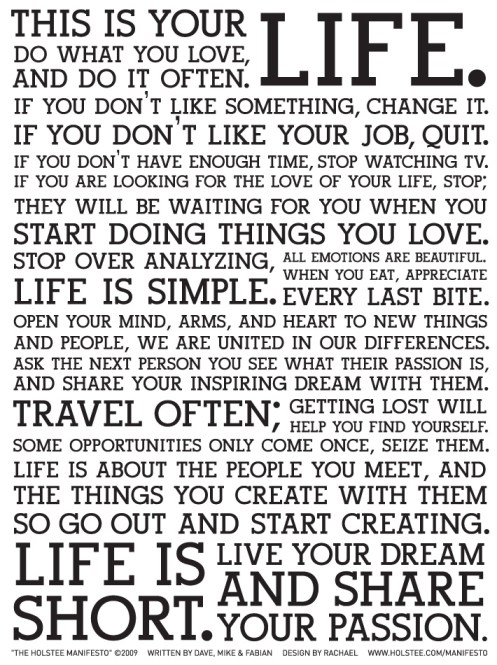
Holstee Manifesto One of the greatest sources of inspiration is Brain Pickings, founded by Maria Popova. The site recently posted The Writing Commandments of Henry Miller. They definitely serve as a great way to approach a writing practice, which comes in as a handy reminder for someone like me. I also posted the Holstee Manifesto, which you can view on Popova’s site as well. There’s a rumor Popova is visiting San Francisco this weekend! I really (really) want to meet this woman and hoping she makes an appearance. In any case, I wanted to snag her post, Henry Miller’s 11 Commandments of Writing & Daily Creative Routine. Did I mention I want to meet Maria Popova? Oh, yeah, I did. Enjoy the post (thanks to Brain Pickings!)
* * * *
The Writing Commandments of Henry Miller
- Work on one thing at a time until finished.
- Start no more new books, add no more new material to ‘Black Spring.’
- Don’t be nervous. Work calmly, joyously, recklessly on whatever is in hand.
- Work according to Program and not according to mood. Stop at the appointed time!
- When you can’t create you can work.
- Cement a little every day, rather than add new fertilizers.
- Keep human! See people, go places, drink if you feel like it.
- Don’t be a draught-horse! Work with pleasure only.
- Discard the Program when you feel like it—but go back to it next day. Concentrate. Narrow down. Exclude.
- Forget the books you want to write. Think only of the book you are writing.
- Write first and always. Painting, music, friends, cinema, all these come afterwards.
Under a part titled Daily Program, his routine also featured the following wonderful blueprint for productivity, inspiration, and mental health:
MORNINGS:
- If groggy, type notes and allocate, as stimulus.
- If in fine fettle, write.
AFTERNOONS:
- Work of section in hand, following plan of section scrupulously. No intrusions, no diversions. Write to finish one section at a time, for good and all.
EVENINGS:
- See friends. Read in cafés.
- Explore unfamiliar sections — on foot if wet, on bicycle if dry.
- Write, if in mood, but only on Minor program.
- Paint if empty or tired.
- Make Notes. Make Charts, Plans. Make corrections of MS.
Note: Allow sufficient time during daylight to make an occasional visit to museums or an occasional sketch or an occasional bike ride. Sketch in cafés and trains and streets. Cut the movies! Library for references once a week.
¶¶¶¶¶
¶¶¶¶¶
¶¶¶¶¶
¶¶¶¶¶
-

Tag and Seek + Beta Testing = Fun As a young professional, I loathed corporate team building as a mandatory activity. Managers required us to participate on scavenger hunts in the hopes of learning about one another and facts about the company. Over the years, I’ve grown out of the surly, young, and overly ambitious individual. In recent years, I’ve grown fond of such activities I once believed juvenile and unnecessary. You might be wondering, what changed? I’d like to think maturity set in and brought me back to the pleasures of curiosity and discovery. Last weekend, I participated in the Tag and Seek Beta test, sponsored by ZERO1. The experience made me realize that any game requires willing participants. Bottom line: It was enlightening and made clear that real time human interaction is important. The experience also showed how technology serves as a conduit allowing for narratives to intersect and become a part of the gaming experience.
Being a blogger, it’s absolutely imperative to curate content for the public and one of the most enriching parts of my job is covering events, exhibitions, or beta testing! Knowing the experience was a scavenger hunt and geocaching based game, I expected some sort of social interaction. Other than that, I wasn’t expecting very much from the experience other than familiarizing myself with San Jose cityscape. Tag and Seek was played using the application, TagWhat, which provided brief descriptions of landmarks and artworks sprinkled throughout Downtown San Jose. The mapping capability underneath the picture and description of the landmark helped us navigate the landscape. Since I had the opportunity to partner with James Morgan, professor of Digital Media Arts at San Jose State University, I had quite the advantage. Ironically, James and I already met…virtually. Through e-mail correspondence regarding an Ars Virtua exhibition, look art, we already started a dialogue about virtual spaces and art experiences (If you’re interested, you can read about the look art exhibition here).
My partnership with James for Tag and Seek resulted in second place after the tags were tallied. Yet coming in second didn’t damper the fact that it was one of the better scavenger hunts I’ve ever played. Although fun, people would probably be more likely to work hard knowing a specific reward accompanies the game. It would be great to receive a badge or star within the app when a particular tag status has been reached so the gamer can readily access how many tags they’ve submitted. The dynamics of game play were much more robust knowing my teammate was interested in conversation as well! Sadly, my battery died towards the end of the game and I had to take photos outside of the app relying heavily on multi-tasking (an iPhone 4 was used during game play). Beyond tagging and seeking landmarks another participant suggested interacting with specific individuals and/or your own team mates to make the game enriching, on a physical and social level. Overall, Tag and Seek is a promising game application and I’m excited to see the enhancements and developments made in the next few months. Again, if you want to learn more about Tag and Seek, click here.
I would also like to invite you in on the the conversation! What apps do you use to connect with friends? What are your favorites? What applications help you learn more about your environment? Please join the ZERO1 conversation on Facebook or Twitter!Originally posted to ZERO1
¶¶¶¶¶
¶¶¶¶¶
¶¶¶¶¶
¶¶¶¶¶
¶¶¶¶¶
-
With a multitude of writing projects going on simultaneously, I didn’t want this one to get left on the virtual stack under the virtual paperweight. I’m hoping to perhaps lengthen this piece and bring in some research. For now, I’ll share it with the world and for anyone interested in reading it. It’s about the work of Nik Hanselmann now based in New York. He graduated with his MFA in Digital and New Media Studies from UC Santa Cruz and received his BA from UC Berkeley in Art History. In any case, he’s one of the artists I would like to include in future research projects and writing. For now, gnaw on this text and let me know what you think. I’m curious how you feel about the body within new media arts. What role does the body play? Or, with technology capturing organic forms and life, does it matter whether or not what you see is a simulation or not? Heady stuff. I know but would love to hear what you think…Enjoy!
* * * *
Working Title: Body and Imagination: The Work of Nik Hanselmann
I am a big believer that work should perform and be as it is — that whatever phenomena you are trying to describe be embedded in the work itself. But I also think that the somewhat anachronistic attributes of past media have a significant weight on how work can be put into conversations today. ~ Nik Hanselmann, Artist
With the release of latest touch screen devices, consumers gather in droves as if making a sacred pilgrimage. Not only do these devotees want the privilege of partaking in the latest technology but these very devices are ways to socially engage and entertain. The multi-layer instantaneous retinal stimulation of our youtube-flickr google-able culture makes participation in society highly accessible. Everyone possesses the ability to create. This is where the artist creates distinctions and a much-needed discourse. Video art, specifically, has taken on countless iterations of the relationship between filmmaker and viewer. In recent years, new media artists have used technologies requiring the viewer to become a part of the production. But what happens when the artist intervenes by taking away the right of interaction and inter-connectivity away from the participant and relegates them to mere viewer?
The creative use (programming) of language to design and, sometimes, fabricate a specific reality or experience is when the medium becomes the subject. Similar to the abstract expressionists, some new media artists find ways to repurpose the tools and techniques in an unorthodox fashion. The alternative method of producing film footage featuring organic forms may not be a foreign idea but programming language as the basis for creating a new format for video art is suggestive of how new media artists push the boundaries of defining the art object. Nik Hanselmann’s work uses the body in different ways and piques the imagination as a point of departure for inquiry into the separation between artist, artwork, and observer in his works, bodyfuck and Observations.
In bodyfuck, Hanselmann created a unique programming language involving use of the body as a means of production. In this scenario, the artist becomes the spectacle. The piece entails a short video of the artist jumping and moving side to side within the frame of the screen. Grandiose gestures and exaggerated movements result in a specific character or symbol revealed to the viewer. As the artist moves, another character flashes on the screen. The cause and effect experience is not too dissimilar to a keystroke on a keyboard. Yet, Hanselmann’s breathy smile results in script that produces a short greeting – Hi. The entire body produces the programming language, the symbols, and the text. In speaking with the artist, he states,
…bodyfuck was comic “virtuosity” or bodily absurdity – something which ended up being a lot more physically punishing than I imagined before I set out to do the project. I think this is really important – and it’s not something that I would wish upon the audience. On a pragmatic level, it wouldn’t really work to have a bunch of non-programmer gallery-goers to be suddenly faced with the challenge or programming. ~ NH
It is the body, in the end, that exerts (maybe even suffers) to some degree, which harks back to the days of experimental video art where the artist performed for the viewer. Yet, bodyfuck serves as a metaphor for the artistic process. Complexity within a process somehow seems to constantly produce something simple that may seem absurd to the viewer but it is the complex set of ideas that lay the foundation for innovation. The serendipitous discoveries lay dormant and only in the artist’s domain. They are revelatory and representative of the way we watch and perceive the existence of the art object. Fictitious forms and organisms in Hanselmann’s piece, Observations, serve as another example of innovative tools used to build a work that reveals something separate and outside of ourselves through abstraction.
For Observations, the decision for non-interaction is to tinge the whole thing with hegemonic mystery. I’m fascinated by the idea of being an agent in science – most of us have little-to-no first-hand experience with most of the concepts that we take for granted. I think the video/screen in this context works like it did on the moon landing or the drop of an atomic bomb. The whole experience is so abstract but told with such authority. That is not to say of course that I think about the fictional phenomena I created on the same level of profundity – I’m merely calling back to this idea that the screen can be a frightening disconnect. In an age of interactivity, I think this gap is widened even further, as most of us can’t wait to get our greasy paws on something to pan, zoom, and eventually hit the home button to go tweet about it. ~ NH
Hanselmann’s works open up the discussion and examination of new media arts multi-faceted and rapidly evolving nature. Definition eludes new media (even though it’s been around for close to 40 years) in large part due to its resistance to fit snuggly into the canon of art history. It remains a vague topic primarily due to its ever rapidly evolving virtual landscape, meaning, and structure. The term new media alone connotes something discovered and innovative but what happens when there is constant flux and change in that very thing we are looking to define. How do we create a taxonomy for this? It becomes a task and a challenge for the artists to look at ways in which the tools can be used differently and perhaps with one another to create abstraction from what is seemingly finite and concrete.
¶¶¶¶¶
¶¶¶¶¶
¶¶¶¶¶
¶¶¶¶¶
-
The bad news is you’re falling through the air, nothing to hang on to, no parachute. The good news is there’s no ground.
~ Shambala Buddhism founder Chogyam Trungpa Rinpoche
Asterisk San Francisco Magazine + Gallery It’s been a pretty exhilarating year thus far. The fact that February is coming to a close is pretty mind-boggling. Sometimes, I have that feeling that I’m not documenting enough but, as the subject line states, breathing is important. I’ve turned blue a few times this year already due to depriving myself fresh air and relaxation. Recently, I started a new role with Asterisk Magazine + Gallery as the space’s curator. Being a San Francisco native, my involvement with Asterisk has been instrumental in my growth and development as a writer. I’ve learned a lot about engagement with the community. Although the experiences have differed greatly from my research, its been integral in my understanding of how people want to read, see, and experience art (and content, both physically and virtually).
I will keep this short and sweet but I invite you, dear reader, friends, and family reading this post, to pay the Asterisk Gallery a visit some time this month and give feedback. On a side note, I recently found out that I got into graduate school! I’m still overwhelmed but really happy about the rest of the year and diving into my research. Rest assured, I believe breathing and meditation will take precedence in the very near future. Currently balancing a full-time 9-5 job, blogging, and Asterisk have proven that stopping every now and again to take a walk and take in some oxygen is muy importante. Again, I invite you to visit the gallery and check out my new academic home for the fall here.
¶¶¶¶¶
¶¶¶¶¶
¶¶¶¶¶
¶¶¶¶¶
¶¶¶¶¶
-
Everything is a Remix Part 1 from Kirby Ferguson on Vimeo.
Please support Kirby Ferguson! Great information, wonderful video, and extremely informative! You will want to watch all parts of Everything is a Remix. Click here to view the site.
¶¶¶¶¶
¶¶¶¶¶
¶¶¶¶¶
¶¶¶¶¶
-
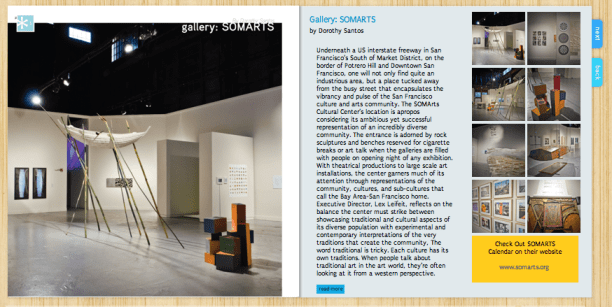
SOMArts Cultural Center Feature in Asterisk Magazine Underneath a US interstate freeway in San Francisco’s South of Market District, on the border of Potrero Hill and Downtown San Francisco, one will not only find quite an industrious area, but a place tucked away from the busy street that encapsulates the vibrancy and pulse of the San Francisco culture and arts community. The SOMArts Cultural Center’s location is apropos considering its ambitious yet successful representation of an incredibly diverse community. The entrance is adorned by rock sculptures and benches reserved for cigarette breaks or art talk when the galleries are filled with people on opening night of any exhibition. With theatrical productions to large scale art installations, the center garners much of its attention through representations of the community, cultures, and sub-cultures that call the Bay Area-San Francisco home. Executive Director, Lex Leifeit, reflects on the balance the center must strike between showcasing traditional and cultural aspects of its diverse population with experimental and contemporary interpretations of the very traditions that create the community, The word traditional is tricky. Each culture has its own traditions. When people talk about traditional art in the art world, they’re often looking at it from a western perspective.
One of the most radical things SOMArts has done since it’s earliest beginnings that is more prevalent now in the field is to combine risk-taking contemporary art with specific cultural traditions. The beating heart of that approach within our organization is the annual Dia de los Muertos exhibition co-curated by Rene Yañez and Rio Yañez. ~ Lex Leifleit, SOMArts Cultural Center, Executive Director
As a community center, SOMArts provides below market value space for interested organizations looking to produce a show or install an exhibition. From visual artists to writers to educators, the center draws patrons and supporters from a multitude of disciplines through several annual events that include Feast of Words and 100 Performances for the Hole (originally conceived by Curator and Gallery Director Justin Hoover). The center also includes a lot of critical discussion through its Commons Curatorial Residency providing curators the opportunity to create an exhibition that encourages the community to engage and learn about art and artists’ practices that may not be readily accessible. Such a residency makes this discussion and dialogue available. Another aspect of the community engagement includes the SOMArts Interactive Video Channel, which fosters community engagement between SOMArts staff, artists, curators, and art lovers.
Originally posted to Asterisk
¶¶¶¶¶
¶¶¶¶¶
¶¶¶¶¶
¶¶¶¶¶
¶¶¶¶¶
-

Artist Profile: Jenifer Wofford To exist within an art community and thrive, one must be able to grow, learn, develop, and maintain an incredibly multi-faceted practice to stay relevant. To take it a step further, as an arts educator and practitioner, it is imperative to make work that is accessible to the public and be ready to engage. Jenifer Wofford is a rare gem in the arts. From artist residencies in Denmark, Italy, and most recently, Norway, she continues to make profound connections between ideas, cultures, and people through her work. Her travels and thirteen years of providing arts education in the San Francisco Bay Area public school district as well as at the university level, including California College of the Arts, UC Berkeley, and University of San Francisco have produced a unique combination of art practice and theory that illuminates as much as it entertains. Wofford thrives on collaboration and participation from her peers as a part of the creative process. Her observations, conversations, and dynamic global studio practice are not only imaginative but showcase a multitude of talent across genres.
When asked about her favorite medium to work with, Wofford stated,
I had reasonably rigorous training in the traditional plastic arts, and so, even if I veer off into more performative or experimental practices, I still often begin from a hands-on, drawing-based approach. I also enjoy drawing, particularly with ink, more than other forms, so it’s the easiest, most straightforward form that I can express myself in. Some projects and ideas reveal themselves to be best suited to remaining within the two dimensional realms of painting and drawing; other projects reveal themselves to be better addressed in video, performance or installation.
In addition to her fine arts practice, her illustration and design work are characterized by strong, bold, non-tentative lines. Past work include, Flor 1973-78, which was a San Francisco Arts Commission Market Street Poster project. Flor provided a fictitious pictorial narrative of a Filipino nurse’s journey from the Philippines to the United States in the late 1970s that included visual references to both the cultural and political climate of the times. In looking at Filipino-American culture and history mixed with tongue and cheek humor, individuals can easily use her work as a point of departure for discussing identity and culture without it being overly abstract and complicated. Her current work, Grand Tour, tethers representations of real-life people to fictitious stories that one wishes were true because Wofford crafts such engaging tales through her drawings and paintings. Lastly, performance-based work with art collective Mail Order Brides will have you convinced that artistry necessitates being a maestro of creativity. You will inevitably find something telling in the way she narrates a story that is intelligent and witty. With a myriad of skills, the common thread, as Wofford explains lies heavily on creating work that allows people a rich experience of art.
There’s always a subtle, or maybe not-so-subtle, politic at work underneath my artworks,” says Wofford. “While the art world is ever-more international, there’s still something of a dearth of voices and perspectives coming from women and people of color, as well as a limited perspective represented from the non-Western world. Since I come from a mixed-ethnicity, mixed-nationality, Third Culture, feminist background, I’ve often felt like I’ve been blessed with a unique opportunity to speak from this perspective, and to give voice in my various projects to something beyond simple formalism or more generalized or codified concepts within Western art. That said, I don’t think I’m doing anything particularly radical, and I dislike anything that smacks of being overly agenda-driven. It’s important to me that my work feel accessible on a number of fronts, and to still retain both a sense of play as well as some formal chops—as far as technique and execution go.
Originally posted to Asterisk
¶¶¶¶¶
¶¶¶¶¶
¶¶¶¶¶
¶¶¶¶¶


 Dorothy R. Santos, Ph.D.