• Hot off the presses…Enjoy!

    *****************************

    Is the imagination a mode of technology? What role does the imagination play in technological advancements such as sensor-laden homes, personal GPS devices, and televisions that can display four channels simultaneously? Artists for Retro-Tech, an exhibition at the San Jose Museum of Art, answer the question of how imagination operates in combination with technical knowledge, and ask the viewer to engage in re-working notions of technology quite imaginatively.

    The exhibition includes Katya Bonnenfant, Aleksandra Mir, Tim Hawkinson, Scott Kildall and Victoria Scott, among others. Each salvages what may have been forgotten by colliding past and present, known with the unknown, imaginary and physical space.

    Mir’s collages re-contextualize imaginary space and religious iconography. She delicately places pious imagery within galactic space. Through such visual dichotomies, the viewer must reconcile unearthly opposites. In Aerial Mobile (1998), Hawkinson utilizes television antennae, fabric, and strings to provoke the viewer into seeing an obsolete object—the television antennae—in a different modality. The object embodies movement rather than functioning as it has historically, to make a moving picture still.

    Bonnenfant meshes old and new technologies in her piece 2:57 Onibaba Anguish from “Vintage Packaging for Animation” (2009). In it, digital animation commands the viewer’s attention via an iPod Touch carefully installed within a vintage clock. Her craftsmanship in re-fashioning a retro digital clock illustrates what happens when imagination works in tandem with technology. Her confinement of the new by the old forces the viewer to recognize rapid change in a digital age.

    The “No Matter” collection is the opposite of its name, but playful semantics remind patrons that these art objects, at one point, were derived from the imagination. Scott Kildall and Victoria Scott venture into a virtual economy by working with

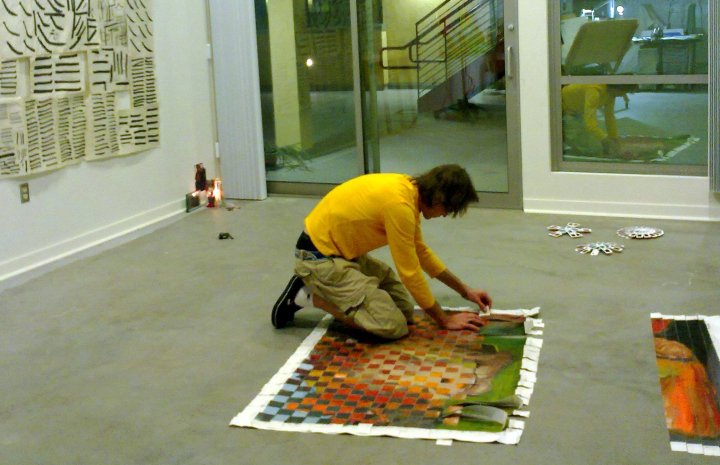
    Scott Killdall and Victoria Scott. Gift Horse, 2010; installation view photographed in progress. Courtesy of the Artists and the San Jose Museum of Art.

    Second Life users to bring imaginary objects into physical space by painstakingly and meticulously creating paper sculptures from inkjet prints on archival paper from digital renderings. In addition, the complexity of Kildall and Scott’s process and production alone couldn’t have prepared the museum staff for the arrival of a monumental thirteen-foot-tall Trojan Horse, reconstructed as a No Matter project and embedded with handcrafted viruses by visitors and artists alike. The horse was “gifted” to the museum and served as an incredible bridge between new technology and old-fashioned art making.

    The exhibition also includes the work of Jennifer Allora and Guillermo Calzadilla from Puerto Rico; the collaborative work of REBAR (Blaine Merker, John Bela, and Matthew Passmore), from San Francisco; Camille Scherrer from La Tour-de-Peilz, Switzerland: Xu Zhen from Shanghai, and Ricardo Miranda Zúñiga, based in New York. Although these artists present varying methods of reinventing old technologies, collectively they show imagination and technology are, perhaps, synonymous. Technology makes one more imaginative, but it is the imagination that provides the impetus for technological advancement and ingenious iterations of the past.

    You can visit the Shotgun write-up here

  • This is a follow up post to the Art 10 Q & A.

    Please view this great video of how Pete created his work, Gender Resolution.

  • This week’s artist is Pete Ippel. Artist and Athlete. You may think to yourself, “Is that really possible?” Yes, it is folks. He’s also quite the prolific artist with art work that stimulates both the physical as well as the cerebral.

    Let’s get to the fun stuff – his answers to the Art 10 questions…

    * * * * * * * * * *

    1. What is your favorite (art) word?

    My favorite word to say is Huitzilopochtli. The word refers to an Aztec god of war and the sun, patron of Tenochtitlan, and is translated as “Left-Handed Hummingbird”.

    Regarding (art) words, I spoke about their relationship with works of art on a “Mediation on Networks” with Stretcher.org back in 2004. http://vimeo.com/8445137 Starting at 3:59 I challenge artists to stop utilizing the standard (art) words to be more like sportscasters…coining new terms to describe new art.   I feel that (art) words are lacking in that they are staid and rarely get revised. It’s time to let those (art) words die and blaze some new trail.

    2. What is your least favorite (art) words?

    Juxtapose it is simply over-used.

    3. What keeps you going when you’re in the studio?

    I have a very disciplined practice that spans a variety of materials and locations.  I make something or learn something new every day.  I’m very good at “locking it down” when I need execute a task by a self-imposed deadline.  I’ve had great success drawing on my experiences as an athlete and a researcher.  I utilize methods of iteration so as an artist, I’m never bored.  My studio is free from distractions, I live quite simply.  I enjoy keeping the windows open and listening to music while I work.

    4. When do you know you’re done in the studio?

    I’m very sensitive to my body and often push it to the limit.  To regain focus I take a break every day at 1pm will take time for a walk or bike ride outside.  Often I can get a second wind by drinking green tea, taking a 20 min nap, and having a snack. I’m done in the studio when I lack efficiency, typically indicated by falling asleep at my desk.  If I need to keep working when I wake up, I will set multiple alarms and sleep for a few hours (typically in 3 hour cycles) and get back to the task at hand.  This has been my sleep schedule since I was 18.

    5. What words do you love to hear at an art show (your show or any show)?

    I enjoy hearing people discuss the work by talking about what they see and how it relates to them.  I especially enjoy hearing individuals explain context and intent to their friends when they are with someone who “isn’t an art person”. The occasional “WOW, I want that in my home.” is nice too.

    6. What words do you hate to hear at an art show (your show or any show)?

    “My kid could do that.”  To me it is a cop out and a refusal to invest or to look at work more critically.  Rarely do the people who say those words consider intent or context – even if their child could execute the  same brush strokes etc.

    7. What is your favorite curse word?

    I made a project about taboo words as an undergraduate.  At the time I was exploring how there’s so many slang terms to describe something that is socially restricted.  If you think of your index finger, you’ve got a few options, digit or phalange…now if you take something like vomit or poo, you can think of ten euphemisms straight away.

    As for a favorite curse word, I’m not particular and use what is appropriate for the situation…I am reminded of the influence of the Conan O’Brien show I saw when I was in high school.  He was trying to figure out how to dodge censors, so he opted for KRUNK as the new curse…This goes along with question 1.  See the video here  starting at 4:50 http://www.youtube.com/watch?v=YrzqaA3w0cA

    8. What profession other than being an artist would you like to attempt?

    I’m an aspiring philanthropist and I’ve set some of the financial wheels in motion for that to happen.

    9. What profession would you not like to do?

    I’ve not considered this too much, as I focus on what I like to do…I think it would be pretty tough to be the person who gives a lethal injection or flips the switch on the electric chair…

    10. If Heaven exists, what would you like to hear God say when you arrive at the Pearly Gates?

    “Heya Pete, nice job down there.” *insert fist bump here*

    You can learn more about Pete’s work by visiting his website AND blog.

    ¶¶¶¶¶

    ¶¶¶¶¶

    ¶¶¶¶¶

    ¶¶¶¶¶

  • Although I’m a San Francisco Native, I LOVE Oakland immensely and believe the Support Oakland Artists organization has set up a great web site to survey the community and create services and increase resources to the art community.

  • Hello Dear Readers, Art Lovers, Art Makers, Art Writers…well, Everyone…Hello, Hello

    I want to follow in the same vein as James Lipton and ask similar questions to artists. I figured it would be a great way for both Art Lovers and those interested in Art a peek into the Artist’s studio life and philosophy. In turn, I want to provide artists with more exposure as well. Making connections for everyone, essentially. It works both ways and I’m really happy talented and funny artist and recent San Francisco Art Institute MFA graduate, Megan Wynne, decided to be my first artist to answer the Art 10 – Inside the Artist’s Studio questions! Thanks again, Megan!

    Questions and Comments are certainly welcome! Enjoy this first installment!

    * * * * * * * * * *

    Art 10

    1. What is your favorite (art) word?

    This may be a boring answer, but I like the word “aesthetic”. I like the sound, the way it rolls off the tongue, and the spelling of it, the “a-e” thing. I also love the word “visceral” even though its not technically an art word alone, I use it a lot when talking about the gut response to a piece of art. It relates to my present body of work, “viscera”.

    2. What is your least favorite (art) word?

    I’m going to have to go with two words on this one because it ruins one of my favorite words, “relational aesthetics”. I find the term irritating and too esoteric.

    3. What keeps you going when you’re in the studio?

    Its usually my interest in learning about the subject matter I’m addressing in the work, the research aspect to the process.

    4. When do you know you’re done in the studio?

    When I start to feel like I’m going to fall asleep or vomit. Its always a physical reaction/symptom that tells me I need a break. As far as completing a piece is concerned, I never really feel like my work is ever finished.

    5. What words do you love to hear at an art show (your show or any show)?

    Its not so much words, but I often like it the best when people laugh when they look at my work. My work isn’t only supposed to be funny but its nice when they get the joke.

    6. What words do you hate to hear at an art show (your show or any show)?

    Once I was at the SFMOMA and a father who was holding is little boy came up to Duchamp’s Fountain and loudly said “Now that’s art” as sarcastically as possible. He acted like he was addressing his son, like it was some absurd art lesson he was giving him, but the joke was really intended for me to overhear, as I was also looking at the piece at the same time. He thought he was so funny. I believe we are all entitled to our own opinions about artwork, but it was irritating that the guy presumed that anyone else within hearing range of his voice would obviously have the same opinion as he did.

    7. What is your favorite curse word?

    The present participle of the “F” word.

    8. What profession other than being an artist would you like to attempt?

    Surgeon.

    9. What profession would you not like to do?

    Nurse – they seem to have to do all the hard stuff.

    10. If Heaven exists, what would you like to hear God say when you arrive at the Pearly Gates?

    I’m not mad at you for being an atheist.

    You can learn more about Megan’s work by visiting her website.

    ¶¶¶¶¶

    ¶¶¶¶¶

    ¶¶¶¶¶

    ¶¶¶¶¶

  • I posted an entry about ‘The Other Other show some time ago and wanted to post something more substantial. This is long overdue and a work in progress. Hopefully, I can give a worthy reflection and summation of the show, which includes artists, JC LenochanEric SanchezLuther Thie, and Kathryn Williamson.

    So, what exactly is the  notion of “Other”? I’ve always thought exploring ‘otherness’ was a rather futile concept until now. I think much of that had to do with my issue of how I consider myself within a group or community. Being a queer Filipina woman, I always thought you can’t more ‘other’ than that, can you? I was very wrong. I know there’s a big ole world out there filled with so many differnt types of individuals into all different sorts of things and creating a wide array of sub-cultures. Yes, I did in fact realize some time ago that there’s so much more to the concept of ‘Other’ and ‘Otherness’ than ethnicity, sex, and gender. Lenochan, Sanchez, Thie and Williamson go beyond vernacular understanding of ‘Other’. They dig deeper than most for this particular show and showcase various perceptions of ‘Other’.

    Lenochan draws us into a history lesson by creating a two dimensional pieces that conjure up an culmination of historical refernces. In the viewer’s mind, there is a re-visiting of textbooks and lectures. The green chalkboard balanced by a muted fire engine red chalkboard are displayed against a large white wall. Remnants of the past help us conceive, even further, the idea of someone outside of ourselves. The viewer starts to piece together their own recollections and fragmented understanding of the past.

    With my own aspirations of looking at ‘Other’, Lenochan does a phenomenal job at utlizing traditional media to showcase a powerful message about the intersections of race, ethincity, culture, sub-culture, histories and a collective conscious through his multi-layered drawings.

    Eric Sanchez’s work, Animalia Hybrids, is a jarring look at the topic at hand via cross pollination of a readily known subject matter – care for other. He alludes to care for other(s), in this case, children and animals or pets through optical illusion. Upon visiting his site, you learn a bit more about the impetus of his project by combining notions of care for children and care for animals or pets. Outside of the gallery, you’ve probably heard a pet owner refer to his/her pet as their ‘baby’ or ‘child’. What I find visually challenging and engaging about Sanchez’s work is that he takes that very notion and shows you and extracts a response of your own notions of care into question. He throws the viewer into a serious connundrum when through his photographic depictions of care for ‘other’.

    Luther Thie’s work combines one’s past experiences and real depictions of real people for the viewer that is randomly generated through a special Jitter program. The engagement required by the viewer is the crux of the piece. Although humorous at first glance, there’s a sense of guilt that sets in as I watched the participants giggling while answering the questions posed by the program. For example, an older chinese man’s photograph would come up with the question, “Do you find this individual attractive?” or “Do you find this individual suspicious?” One begins to take into account the very nature of their own judgements of ‘other’. The questioning then turns to the viewer and how they are perceived by others. The circular effect created by Thie’s work is a testament how the questioning ‘otherness’, we start to question ourselves.

    ¶¶¶¶¶

    ¶¶¶¶¶

    ¶¶¶¶¶

    ¶¶¶¶¶

    ¶¶¶¶¶

  • Went to the Art Murmur in Oakland, CA last Friday, September 3rd. Specifically, I went to the Other Other opening curated by curatorial collective, OFFSpace. It was a great show about, well, “otherness”. I won’t get into it right at this minute but since a few more people (yes, thank you, dear friends) are keeping up with the blog, I wanted to stay connected. For now, take a look at these artists…they comprised The Other Other show…

    The show will be up for some time (another month or so, I believe). Visiting the artists’ sites is a great way to get an idea of the art work being made but there’s nothing like actually seeing the work. Again, I’ll be posting more on my impressions but I definitely encourage you to check out the show, if you’re able.

    The Other Other Artists include JC LenochanEric SanchezLuther Thie, and Kathryn Williamson

    Curatorial collective OFFSpace

  • I know, I know.

    I should be writing about an artist I don’t really care for or agree with because that would make for an interesting piece of art writing but this is an art diary (of sorts) and, well, I can write what I want (for now)! I’m sure my writing will go into varying directions in the next month or so with a studio class on the horizon. I digress (per usual). For those that know me well, I preface (quite a bit) but I did that (yet again) because I constantly write about artists that inspire and move me.

    Ellen Gallagher being one of those artists. Being a fan of Art 21, I found myself engaged by her work. The ability to take imagery and appropriate it in a repetitious fashion but making all iterations worthy of a look amazes and excites me. A great example of her collaborative work is the ‘DeLuxe’ Prints series. She adds to an image of Isaac Hayes in such a way that the viewer is forced to re-imagine a narrative. Her re-telling of a history through painting over what is there, magically, uncovers what has long been concealed. Think of that contradiction? Covering up to uncover. Re-appropriating to make appropriate, inevitably be re-appropriated and re-configured in the viewers mind. Gallagher works wonders. I guess I wrote about her because I’m hoping to do some of my own magic in this upcoming studio art class. We shall see!

    Learn more about Ellen Gallagher here

    ¶¶¶¶¶

    ¶¶¶¶¶

    ¶¶¶¶¶

    ¶¶¶¶¶

  • Some time ago, I was introduced to the work of Sonya Clark. It encapsulates the truth, which resides in our bodies. Hair, for example, contains information about our biology that we often neglect or forget. Our predispositions, if you believe they exist are engrained in every part of the body. Clark explores hair in such a way that brings her understanding and experiences to everyone (not just African-American men and women). One of the many reasons I love Clark’s work is in large part due to use of the body and the tools we use to maintain our bodies. The Combs Series evokes how something so simple and trivial can reflect complexities and intricacies of beauty and self-care. Clark’s utilization of simple materials to create visual complexity contrasts how combs are often seen as cheap, plastic, low quality tools used simply to groom unruliness.

    Clark notes on her site, when talking about her projects entailing use of human hair,

    “Deep with each strand, the vestiges of our roots resound. In this work hair is formed into markers of chronology, wisdom, and adornment”.

    Much of her work resonates with me because in the past few years, I’ve had probably close to a dozen different hairstyles in the past couple of years. Co-workers even rumored that I had shaved my head, which is far from the truth. I merely had an extremely short pixie hairstyle someone misspoke and interpreted as a shaved head. In any case, it dawned on me the importance people hold on hair and beauty. Some women allow such an external characteristic to define their femininity. Yet, Clark doesn’t (only) re-make and re-interpret her body to create beautiful pieces of sculptural work. She believes in showcasing how the body itself can serve as a medium. She profoundly sculpts the truth in our bodies within her work.

    Please visit her site here

    ¶¶¶¶¶

    ¶¶¶¶¶

    ¶¶¶¶¶

    ¶¶¶¶¶

  • Another (recent) short paper I wrote on artist, Fernando Botero, for the course, Contemporary Art: History and Theory taken at UC Berkeley Extension (for Post-Baccalaureate Certificate in Visual Arts).

    ************************************

    One of the fundamental lessons in drawing class entailed drawing untold numbers of fruit, boxes and bags.  The exercises were required to instill the importance of actually depicting what existed in reality versus what the mind believes or thinks exists.  I was often reminded that we first see everything the wrong way and that it is our brain that turns everything right side up.  Understandably so, as the world and human cognitive processes evolve, ways of governing ourselves and let’s not forget the ways in which we’ve created social and gender constructs to function in the world and society at large; we often forget to try and understand a photographic depiction.  We take it for what it is.  From finding a photograph aesthetically pleasing to a sense of repulsion, there are instantaneous reactions.  It’s the closest depiction of reality and how we physically see something.  Yet, with post modern nuances of art entailing a conceptual and performative slant, it should not be forgotten the effectiveness of painting.  I would like to ask the reader to combine the tenets of philosophy and art to re-contextualize the way in which painting, in contemporary times, can offer a much more powerful way of understanding politics and how it coveys philosophical concepts in such a way language is unable to capture.  From Botero’s classical painting techniques, the viewer is afforded the opportunity to navigate biopolitics (as Foucault has coined), social constructs and ideology through the canvas.

    Reading through Eduardo Mendieta’s paper entitled, Moral Optics, my interest was piqued in how philosophy and art are combined.  We see this convergence in post modern thought and art practice.  He discusses Foucault’s Biopolitics and its relationship to seeing as correlated to biopolitics and biopower.  From this, the reader gains a broader understanding of how Botero’s paintings take the imagery of Abu Ghraib produced by photography and brings the seeing to an inevitable understanding of torture through re-contextualization via painting.  Mendieta inculcates the reader to re-examine and learn new ways of seeing Foucault’s archeological dives into the human condition through histories of sexuality and power, which is integral to the current discussion yet for the scope of this writing, the points most correlated will be highlighted.  In his reflection of Foucault’s look at politics and power, I find myself most concerned with the following:

    This new form of political power, or biopower, has evolved along two axes. Along one axis, it has developed a series of disciplinary technologies that come to bear upon the body as a machine. These technologies conform an anatomopolitics that aims to optimize the capabilities of the body by rendering it more docile and pliable to be inserted within systems of economic and political control and efficiency. Along the other axes, the body is treated not singularly but as part of a spe- cies, a genera, whose basis is entirely biological and organic. Here the body is seen as part of a system of life processes: birth, mortality, health, life expectancy, and anything that increases or decreases any of these. The body is seen as an instance of a species falls under the regulatory controls that conform a biopolitics of populations (Mendieta, 6).

    First, understanding that there is a way in which a viewer perceives their own body within a culture, a society of bodies, is crucial.  If we were to examine Botero’s painting from a philosophical standpoint.  There is an act of knowing and acknowledgement that must occur prior to engaging in Botero’s work.  With the base knowledge of the body being part of a larger system, the body and mind become part of a larger system of symbiotic relationships.  Exploration of those power relationships that Foucault is so well known for is all the power relevant in political and contemporary art.  The contemporary art museum and gallery patrons can see this with the advent of specific types of museum and gallery collections (ie., Museum of African Diaspora, alternative art spaces to reach and represent various under represented minority groups, etc.).  With many various groups in the arts and although a completely different discussion, I felt compelled to start with a specific way in which to view post modern (contemporary) painting from this lens.

    One of the reasons Botero’s paintings are extremely effective is due to a certain level of detachment the viewer experiences at first glance.  There is a stage of processing that occurs which does not necessarily seem to be present in photography.  Since photography is the closest depiction of reality, painting offers a graduation in perception and comprehension.  As I mentioned in the beginning of the piece, when one learns how to draw and paint for the first time, there are various techniques incorporated into the teaching that force the student to view only the shapes, lines and form of the object.  One of the methods, from my experience, includes looking at an actual photograph upside down to relieve the mind and brain of affixing a meaning.  In a way, this is what Botero’s paintings allow the viewer to do.  Mendieta explains several ways in which one can view the art works claiming that:

    On the one hand, fatness stands in his paintings for the excesses of the privileged classes, which more often than not are ridiculed, scorned, and demoted. The haughty expressions, the ornate dresses, the regal accoutrements, the imperial posturing, are all neutralized and deflated by the heaviness of unbridled and undisciplined bodies. On the other hand, this very same abundant, solid, cherubic and baby-like fatness can be read as a form of humanization. What from an angle can be seen as an anxiety, from another angle, provided within the paintings themselves, allows us to see a vulnerable subject. Against a bourgeois, imperial, sovereign subject –Cartesian, Kan- tian, but most exactly, against the Cortésian and Pizarronian subject—Botero juxtaposes the cor- poreality of the flesh that is undisciplined and undisciplinable. We are irreducibly creatures of bod- ies that hunger and can die both of starvation or gluttony. Our flesh thus is always a source of a profound unease, for it can betray us to the same degree that it is what makes us vulnerable to another’s violence (Mendieta, 8).

    The very fact that Botero’s paintings bring up quite a dichotomous way of seeing and thinking in terms of how we place ourselves in time and space is what makes painting such a relevant art form in contemporary times, if and only if the painter makes the wise decision of provoking the viewer into that stage of detachment to see what is actually there and what ought to be understood.  Comprehending in such a way that questions acts of violence and torture through an understanding of the body is only possible if the painter creates something that we cannot easily place meaning upon.  In many ways, showing us what we think we know in an unparalleled and unconventional way.

    Overall, the framing of the subject and the artist outside the frame is integral in understanding Botero’s work.  As Mendieta points out with meditations on photography, painting has the ability to recontextualize systemic issues for the viewer that lead to a greater, deeper understanding of social, cultural ills.  In Botero’s case, specifically, painting offers a multifaceted perspective on the biopolitics of torture.  Mendieta asserts:

    Painting has re-claimed its sovereignty over the field of representation and perception. Susan Sontag wrote, “photography is, first of all, a way of seeing. It is not seeing itself”…Painting, after the age of the mechanical reproducibility of chemically produced perceptual equivalences, teaches us that seeing itself is a way, a framing (Mendieta, 2).

    Work Cited

    Mendieta, Eduardo.  Moral Optics: Biopolitics, Torture and the Imperial Gaze of War Photography.  Stony Brook University, New York.  2009.