


I had two entertaining conversations (both on separate occasions) in the past two weeks. The Understanding Perception posts are dedicated to two intelligent men who, admittedly, have said, “I don’t get it!” when discussing Modern and Contemporary Art. Their innate curiosity and willingness to exchange ideas prompted me to write.
Now, Justin and Josef, I’m not trying to persuade you to fall in love with Modern and Contemporary art. Although I’m a huge fan of both, your opinions are valued and respected. What was important to me was your inclination to delve deeper into why you think Modern and Contemporary artists (specifically, abstract expressionists and conceptual artists) don’t make (what you define as) art.
This is my attempt at taking what is purely retinal and showing how art evolves through a series of radical changes in practices, philosophies, and a desire to involve the viewer on a much more intellectual level. Art, truly, is a living thing. Remember, there was a time in history when art was used, primarily, to tell a story (i.e., Catholic Church), especially, for people who were considered uneducated or completely illiterate (i.e., thank you again, Catholic Church and Colonialism – that’s another issue for another day). With time, Art’s function shifts and even can go against function. With all this change, it makes sense that many forms of art have evolved into such a multi-faceted experience.
* * * *
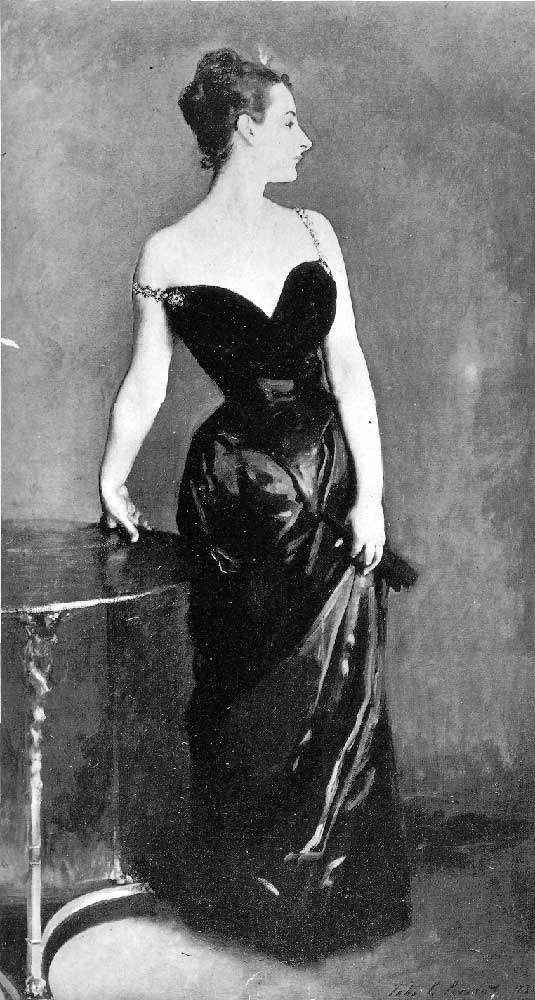
Having recently finished the book, Strapless by Deborah Davis, I felt obliged to use the subject of the book as an example of representational art. The sense of sight is activated, you receive all the visual data you need, and your memories and experiences tell you what you’re looking at. For many people, this painting is a close composite to what may be found in the real world. A woman. A Black dress. A white woman wearing a gown. You’ve got the picture, literally.
However, in 1884, this painting was rejected by art critics and the general public because it was such a departure from its subject, Virginie Amelie Avegno Gautreau, also known as Madame X. Her skin was corpse like white with an awkwardly positioned arm, and a fallen dress strap (which didn’t bode well within Parisian Belle Epoche). Essentially, the fallen strap was scandalous. In retrospect, it was Sargent’s way of introducing something innovative in portraiture. Yet, what about someone like me? Since I’m a woman of color, it means something different to me. Madame X was a dilettante housewife and socialite that went to great lengths to keep her appearance pristine. In many ways, this is not a portrait of an average woman in Parisian culture. The portrait means nothing to me but, technically, it’s an amazing testament to Sargent’s deftness with a brush but it’s a part of art history I can’t deny, right? I can’t dismiss it because it doesn’t resonate or relate to me. It’s an artifact. Yet, in any case, this is what most people know and define as art.
Bottom line: This painting is a purely ocular experience. Isn’t it? You get what you see, for the most part. Granted, it’s all the more interesting when you know the story behind the painting and I think that’s what intrigues people the most – the back story.

Next, there’s Marcel Duchamp. Some people love him or you hate him. Either way, he’s another important figure in art history. This painting, Nude Descending a Staircase, is an abstraction of, well, a nude model descending a staircase! The architectural nature and form that the lines create are significantly different from the portrait of Madame X. Your eyes give you information but it may not necessarily match up with what you know about a real life nude (let’s say, a woman), correct? Would you have known it’s a woman or man descending a staircase? Why or why not? Does it even matter? There is a particular visual rhythm you see here that gives you all the visual clues necessary to ascertain that this is a figure in motion. Another aspect of abstraction is that you’re not being spoon fed the content. Forget about a subject or a figure. There’s something greater at work. You’re no longer thinking about an individual, you’re senses along with your cognition are working to make you think of other things (i.e., motion, tradition vs. avant-garde, etc.).
Bottom line: Representation gives you what you know. Abstraction gives you what you don’t know so you think.
I know, I know…one of you mentioned to me that you don’t like art that makes you think but you were willing to hear me out and exchange thoughts about art history (i.e., effects of the advent of photography and what it did to painting, innovation, post war, etc.). 🙂
All right, I’m going to end here.
We’re getting closer to looking at the smudges and smears on the museum walls and canvases that prompt you to ask, “WHY is THIS art?” I’m getting to it…




 Dorothy R. Santos, Ph.D.