What is it about the construction of the human mind that makes the interplay of words and images seem, despite innumerable historical and regional variations, to be something like a cultural universal?
~ W.J.T. Mitchell, Word and Image essay from Critical Terms for Art History
At the moment, I’m taking a Voice and Vision class at the San Francisco Art Institute through the Continuing Education program. We’re learning how to incorporate text and words within our work. It’s pretty difficult to make something that looks effortless and not contrived. Well, for me, this is the case. Seriously.
One of my favorite artists is Travis Somerville. We study his work quite a bit. I’m absolutely enamored by his technical skills and concepts. I had the opportunity to meet and talk to him early this year. What a night but I digress. Looking at his work, a lot of what he does is convey his understanding and experiences of the South and its history and culture. Still, you can’t fight the feeling of wanting to do what you think people want to see. He doesn’t do that. He just produces and it’s always some of the amazing stuff I’ve ever seen. Yes, I am an art writer but making art helps me understand the creative process. Overall, the class has been enlightening and rewarding. I’m one of those artists that can’t escape words and I’m starting to accept that fact. I’ve got more of an illustrative style and THAT is okay.
ZER01 Arts/Technology: In Conversation with Ken Eklund and Sibley Verbeck (Photo by: Irving Perez)
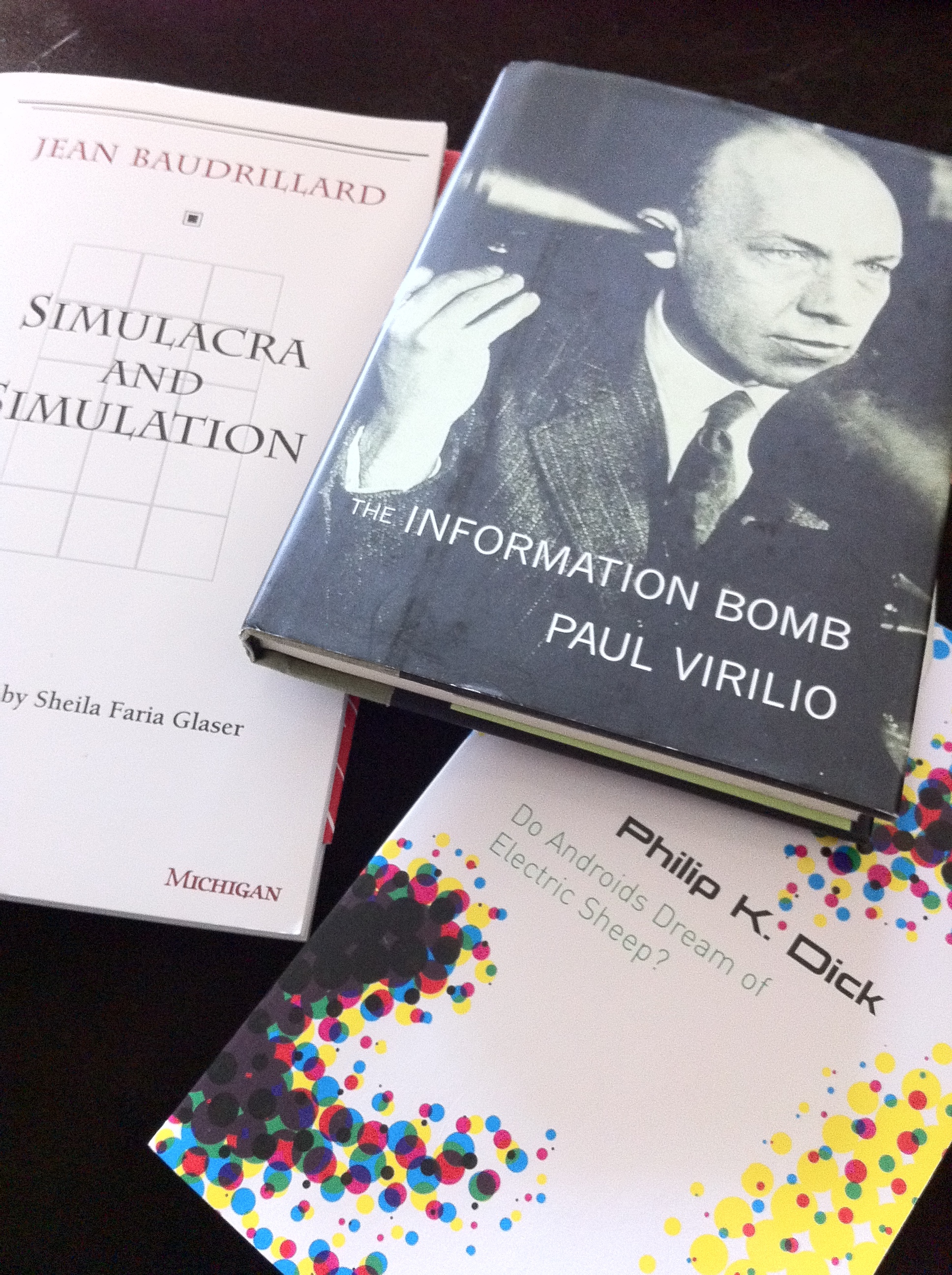
He thought, too, about his need for a real animal; within him an actual hatred once more manifested itself toward his electric sheep, which he had to tend, had to care about, as if it lived. The tyranny of an object, he thought. It doesn’t know I exist. Like the androids, it had no ability to appreciate the existence of another. He had never thought of this before, the similarity between an electric animal and an andy. The electric animal, he pondered, could be considered a subform of the other, a kind of vastly inferior robot. Or, conversely, the android could be regarded as a highly developed, evolved version of the ersatz animal. Both viewpoints repelled him.
~ Philip K. Dick, excerpt from his novel, Do Androids Dream of Electric Sheep
Fortunately, as long as humans exist, there will always be a desire to know the other. Advances in the way we communicate and connect with one another is in large part due to interactive gaming and social networking applications. Last Friday, under the dim lights of the Gray Area Foundation for the Arts (GAFFTA) subterranean level where the Future Canvas 2 exhibition of iPad art was on display and SpacEKraft supplied ambient participatory music; ZER01 presented Art/Technology: In Conversation – Future of Play II with game artist, Ken Eklund, and StreamJam Creator, Sibley Verbeck. The setting was apropos. Engaging the public and facilitating dialogue at the intersection of Arts and Technology is primary objective for both organizations.
Ken Eklund began the evening with a brief yet colorful PowerPoint presentation which informed the audience of his early interests leading to interactive game design. From 16 bit color video games to political science, Eklund’s well known game, World without Oil, demonstrated his desire to affect change in the world by having end users partner and collaborate on pressing issues. Although education within the the Arts and Technology realm is imperative, social networking within virtual spaces has become an increasingly popular mode for interaction. The human imagination has the freedom to create avatars and interface with friends from where ever they choose. With his work in computational research, founder of Electric Sheep Company, Sibley Verbeck displayed screenshots of virtual worlds created predominantly for commercial use to enhance the viewer’s experience with a particular product or immersion into a dramatic television series.
Varying rationales and intention for interactivity and participation helped make the discussion between Eklund and Verbeck dynamic. Two methodologies of using game design and virtual worlds as a place for social networking yet with differing purposes, brought philosophical ideas to the fore. While Eklund’s purpose lie in social change and education, Verbeck’s ultimate goal was to create worlds where people could socially interact based on a common interest such as music hence the creation of StreamJam. Another topic involved notions of the self. The filtration of a Virtual self vs. a Physical self and whether or not a convergence between the two is possible or whether a virtual self is an abstraction and representation of the physical self. Related to the aforementioned subject, the differentiation between an alternate reality as opposed to a virtual world was discussed. The alternate reality relies on the physical self to find aspects of the game embedded into a particular landscape, which may not be within a virtual environment while virtual reality is situated purely in a simulated environment.
As the speakers wrapped up the presentation and final points were delivered, the question regarding whether there is a distinction between an artist and technologist remained. New media arts is constantly re-defining and defying itself amidst the contemporary creative minds taking new technologies and innovative approaches to serve as a mode of conveyance inevitably bridging and providing various ways of communication in this ever changing and fast moving landscape.
Originally posted to ZER01, please clickhereto view.
If you’re into storytelling, love reading, and writing, Mencher’s work will not disappoint.
Mencher has posted a new flash fiction competition on his blog for anyone interested. His plan involves creating a another Renovated Reputations show. The exhibition will be at Ohlone College’s Louie Meager Art Gallery in February 2012. The space will be converted into a 1930/40’s cabaret set in conjunction with students performing monologues based on the stories.
It is the whole traditional world of causality that is in question: the perspectival, determinist mode, the “active”, critical mode, the analytic mode – the distinction between cause and effect, between active and passive, between subject and object, between the end and the means. It is in this sense that one can say: TV is watching us, TV alienates us, TV manipulates us, TV informs us…In all this, one remains dependent on the analytical conception of the media, on an external active and effective agent, on “perspectival” information with the horizon of the real and of meaning as the vanishing point.
~ Jean Baudrillard (French Philosopher), excerpt from his book, Simulacra and Simulation
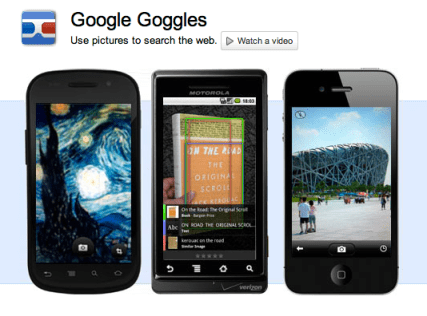
Click on the image above and check out Google’s new application, Google Goggles. The introductory video showcases Google’s new visual search application for Android phones. Basically, you can take a picture of ANYTHING and Google Goggles will provide the information you’re looking for. For example, don’t know the name of a landmark or a mysterious painting, say no more, you can launch your Google Goggles and it gives you all the info you need. It can even give you information from a business card. Pretty insane if you ask me. The video is a couple of minutes long (2:02 minutes to be exact). Yes, it can even translate text from a menu if you’re travelling and don’t know the language. Writing this makes me think of the work of Tim Roseborough, specifically, his latest work – Englyph. Imagine the information Google Goggles would retrieve for you based on this logographic system!! Technology is wild. I’m telling you!
Related to this topic, I have a post regarding Art Project by Google. Click here to view.
Feel free to tell me what you think of these applications and the future of social interaction, human memory, etc. So much to discuss. 🙂
Volunteering at GAFFTA has been an amazing experience thus far. Learning how art and technology converge and intersect has really got me excited about the future of art. At the same time, I’m venturing back into the philosophy and critical theory I read in college as well as exploring new text.
With the latest UpgradeSF meeting and attending GAFFTA exhibitions and artists talks (some of the most amazing minds gather at these events, by the way), I’m excited to be in the midst of re-defining new media arts and witnessing creativity and innovation amongst scientists, engineers, interactive designers, programmers, and coders. Art has always been used as a way to educate people and reflect what is current in society and culture.
Yes, people, a drawing on an iPad, an imagined landscape that requires participants in an alternate reality or virtual world, or a logographic system of language can all be artwork (the artist of course dictates what is produced and whether or not it is artwork BUT this is a whole different discussion).
So, tell me, what is your definition of New Media art?
Regionlism is defined by the Merriam-Webster online dictionary as, “consciousness of and loyalty to a distinct region with a homogeneous population“. Well, I highly doubt the ‘homogeneous’ part. San Francisco is home to such a diverse population. In any case, I had the pleasure of attending the fourth official Upgrade SF meeting and the discussion entailed regionalism within the New Media Arts specific to the Bay Area.
This past meeting included the following speakers:
Each presenter explained their role in the Bay Area Arts and its relationship to regionalism. Yet, each showed how their role and organization defies the notion of regionalism. Siembieda shared an interesting thought – the actual physical place of Silicon Valley serves more as a concept versus an actual location. In order to understand, and connect with a broader audience, ZER01’s approach relies heavily on building these networks across disciplines and inclusion of the entire Bay Area (not just Silicon Valley). Events such as the ZER01 bienniel showcase and present a festival of new media artists as well as activities that involve participation from the community and offer participants access to the artists and the technology behind the art.
Worel discussed OFFSpace’s objective to have the art relate to its space and that regions will have a specific voice. Yes, this is OKAY and it’s what makes the Bay Area fertile ground for innovation. The combination of art work, both static and participatory, within unorthodox spaces (i.e., 2010 Proliferations exhibition in two distinct locations: 1) a wealth management company and 2) a Public Storage unit) speaks volumes of how changing the exhibition model to challenge and excite viewers is crucial in building and forging prominence in the art world, not only nationally but globally.
Finally, van Zwoll ended the talks with her thoughts and experiences as an art dealer. One of the points she mentioned involved defining and re-defining new media art. Seriously, when the ancient Greeks were theorizing about the human soul and creating formal logic, they proably thought they were modern. People and environments change. Like anything in this world, disciplines and practices evolve. As van Zwoll noted, when photography first came onto the scene, THAT was new media. Overall, each presenter represented and contributed greatly to the discussion of regionalism by sharing how changes to the art world models and notions of the art institution/organization, curatorial practice, and the gallery can affect positive change and how New Media artists and community can contribute to that change.
It is a great corner site, an exciting but exhausting gig painting in the micro climates of the scaffolding. Hot on one side and cold on the other. Sweet and sinister, everyday living mixed with screeches of pain. My favorite compliment this week: ”The Hummingbird is a motherfucking powerful bird.”
~Excerpt from Johanna Poethig’s Blog
Bay Area visual, public, and performance artist, Johanna Poethig, created a blog to document the process of her latest mural project located in the Tenderloin district of San Francisco, CA. Muralism is a huge part of San Francisco’s culture and I’m ecstatic to see Poethig chronicling all of the unique stories that go along with the process. Enjoy!


 Dorothy R. Santos, Ph.D.