I went to the Night Light: Multi-Media Garden Party at the SOMArts Cultural Center. It was great seeing friends and meeting some wonderful artists. Below, you’ll find some footage I shot of Radka Pulliam‘s piece, Up and Down the Street. It’s quite clever in that the viewer must “look in” the building to “look out” at the street view. The placement was spot on since it was in a relatively inconspicuous place towards the front of the entrance. I noticed people stopped when they noticed someone looking down and ponder the location of the projection.
One of the memorable performances of the evening was the Spanish Contemporary dance routine of Elias Aguirre and Alvaro Esteban. They are amazing. The isolations and articulation of their bodies is best seen in person. If you were at Night Light, you would know exactly what I’m talking about. Fortunately, there is a video of this phenomenal Spanish Contemporary Dance duo.
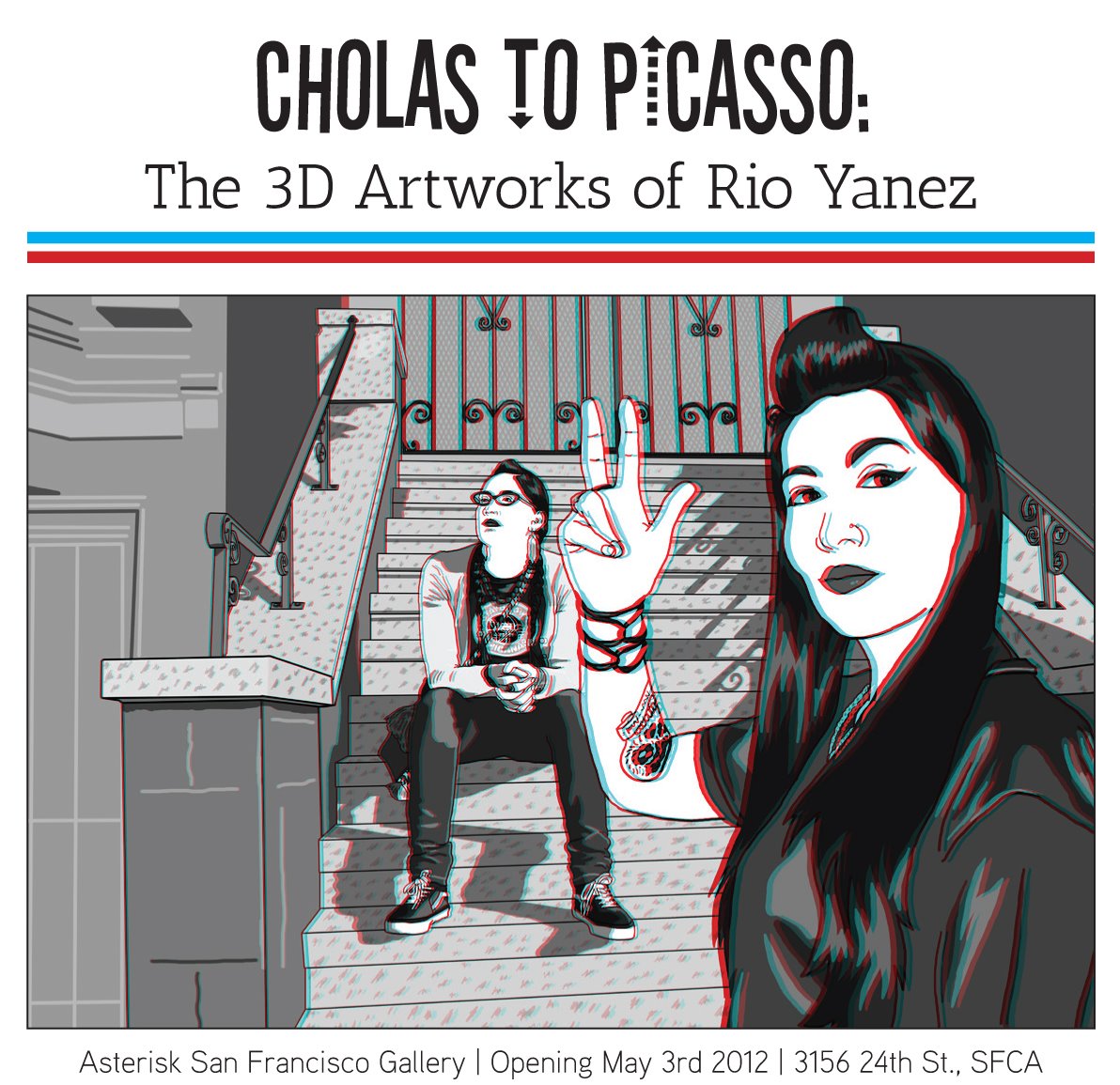
ASTERISK SAN FRANCISCO GALLERY PRESENTS, Cholas to Picasso: The 3D Artworks of Rio Yañez
Exhibition runs: Thursday, May 3, 2012 – Friday, June 1, 2012
Opening Reception: Thursday, May 3, 2012 7PM -9PM
3156 24th Street, San Francisco, CA 94110
Gallery hours: Wednesday to Saturday, from 11am -7pm
Asterisk San Francisco Gallery is pleased to present Cholas to Picasso: The 3D Artworks of Rio Yanez, a collection of 3D drawings and photography. Please join us on Thursday, May 3, 2012 from 7-9pm for the exhibition opening.
As a native San Francisco artist, curator, and photographer, Yañez includes the viewer into the art experience. This show is particularly meaningful as it is Yañez’s first solo exhibition in the neighborhood where he was raised. In Cholas to Picasso: The 3D Artworks of Rio Yañez, three-dimensional works of his ongoing series, The Ramirez Sisters, depicting two siblings and their parallel lives in San Francisco’s Mission District takes on the form of sequential art. Although Yañez negates text, the images of the sisters evokes a strong sense of the how the city shapes the sisters’ individual identities. With his re-contextualization and imaginings of Frida Kahlo and Picasso inspired works, the images mesh into the contemporary fabric Yañez calls home. His photographic works depict the richness and vibrancy of San Francisco. Through Red and Cyan colored lenses, the dynamic simulation of being in these moments of creation is brought to the participant. The textures and scenes of the city enliven the urban landscape. The three-dimensional facet of the works are also kinetic and engaging as they lure the viewer into participating into the city’s infectious and energetic spirit.
About the Artist
Rio Yañez is a curator, photographer, graphic artist, and San Francisco artist. As a curator, he is a frequent collaborator with his father, Rene Yañez, and the two have been developing exhibits together since 2005. He has exhibited in San Francisco, Santa Barbara, and Tokyo. His reimaginings of Frida Kahlo have included the Ghetto Frida Project, a series of prints, writings, and performance pieces featuring a thugged-out Kahlo. Yañez is also a founding member of The Great Tortilla Conspiracy, the world’s most dangerous tortilla art collective. Most recently, his work is featured alongside Miguel “Bounce” Perez and Susie “Tendaroni” Lundy in current exhibition, The Fashion World of Jean Paul Gaultier: From the Sidewalk to the Catwalk at the De Young Museum. Yañez received his BFA in Photography from the California Institute of the Arts. He currently works and resides in San Francisco, California.
Asterisk San Francisco Gallery is located in San Francisco’s vibrant Mission District. The gallery was founded in January 2012 by Asterisk San Francisco co-founders Chief Editor, Jeremy Joven, and Managing Editor, Alex Winter. The gallery focuses on supporting emerging artists within the Bay Area community. It is also available for art openings and single evening events. Rental of the space is available upon request.
Gallery hours are Wednesday through Saturday from 11 am to 7 pm. To visit, please visit us at 3156 24th Street (at Shotwell), San Francisco, CA 94110.
Lots of philosophical thought and art making happen here
Hypercubes by Allison Holt
There is SO much going on BUT I had to take the time to share a few photos I took during my studio visit with new media artist, Allison Holt. I’m looking forward to settling down and writing a piece about my conversation and visit with Holt. Her re-telling and artworks of the different energies and hybrid realities through her Fulbright research of Javanese culture is not only fascinating but yet another example of how artists can impact a community and engage in dialogue and discourse across cultures. Again, looking forward to posting parts of my interview with Holt as well as some reflection on her work.
I previously posted videos of the Hypercubes here. They’re extremely meditative, which I will get into during my write-up. For now, enjoy the studio visit photos and videos! If you have any burning questions and/or comments, please feel free to share and comment below. 🙂
Change the instruments, and you will change the entire social theory that goes with them. ~ Bruno Latour, 2009
Besides ghosts and the government, data is ubiquitous. Consider the abundance of data we interact with on a daily basis (i.e., talking to Siri, logging on Facebook, Tweets, etc.). It’s undeniable, data is a commodity. From monitoring spend to formulating metrics on production of goods, data is necessary for our economic livelihood and growth. I wouldn’t be surprised if a verbal morality standard were implemented in the future! With every passing moment, It grows exponentially and there are probably more data sets in your life than you actually know about. Recently, I attended the Swissnex San Francisco talk, Data as the New Oil: The Journey from Privacy to Publicy, the speakers for the evening included futurists,
Stowe Boyd, social anthropologist, head of research at Work Talk Research, an independent research cooperative
Andreas Weigend, Stanford professor, consultant, and founder of The Social Data Lab
Each had compelling arguments for their particular stances, which varied from opacity with one’s information to complete transparency in the virtual world. Whether you consider yourself being highly active online or have very little virtual presence, the discussion around this topic is imperative.
Gerd Leonhard (@gleonhard) started the evening’s presentations. Leonhard discusses various types of data we use such as volunteered data (i.e., online purchase) to access and use for business purposes. From studying abroad to logging our whereabouts, we suffer from what Leonhard stated as ‘control-loss’. One of the more striking inquiries he ponders is which company will be the next BP ExxonMobil disaster but in regard to data security? The media report on security breaches and leaks from time to time but do you believe a devastating data leak with significant environmental, cultural, and societal effects could actually happen? The question is definitely worth exploring. A futuristic Space Odyssey-Hal 9000 moment entailed Leonhard reminding us of artificial intelligence and its capacity to become robust and dynamic. For example, the iPhone 4S technology, Siri, gets better everyday. The more data we give it, the more robust and intelligent it becomes. Artificial intelligence doesn’t suffer from unpredictable human emotions or experiences nostalgia (unless, maybe, if we’re talking about Data, cyborg from Star Trek). Rather, it takes our information and creates value based on the content. Lastly, one important aspect of data production and consumption is how we, collectively, keep what Leonhard believes is “the ethos of the commons”. In the desire to be open, there’s a lot of risk and vulnerability attached to that type of transparency. Even though good data creates good content, the opposite is just as true.
Co-founder of openthefuture.com and futurist, Jamais Cascio (@cascio), was passionate about his stance of opacity or asymmetric transparency when dealing with data in the virtual realm. Out of the four presenters, his thoughts on the future of data incorporated more radical ideas such as the aforementioned asymmetric transparency (versus symmetric data transparency). Essentially, incorporating a level of opacity when inputting data into a system or database. He argues ‘Opacity’ has value and poses the question, “Do you tell Facebook your actual location?”. For most us, the answer is probably no but then again, we all indulge in omitting our locations for the sake of privacy. Cascio believes lying to the Internet, versus giving up your power to it, is a necessary practice in order to sustain one’s privacy. He compares and contrasts the difference between a natural resource such as oil versus a resource like data. Oil will run out due to its limited supply but this isn’t the case with data. Currently, Cascio estimates around 800 billion gigabytes and by the year 2020, there will probably be around 35 zettabytes (increasing data 45 times over!). With a resource that abundant and seemingly infinite, how can we possibly keep our identities and information in a regulated and structured way? This is a tremendous task, which is why Cascio’s notion of ‘Opacity’ is not too far-fetched.
Stowe Boyd (@stoweboyd) looks at social media and networks. His primary interest is how we interact with one another. Although some of the ideas Boyd asserts are not necessarily new, such as his perspective on advertising, which is derived from an amalgamation of data. Data fuels our desires for things we may not really need to are led to believe we want! Yet, Boyd presents this familiar thinking by drawing on connections with actual physical research not often discussed on a highly public forum such as genetic profiling. Although we have little control over the way our data is used, Boyd suggests knowing how we interact within a societal context, not only virtually but, within physical space. Collectively, we have the capacity to take data and use it as a valuable and meaningful resource that actually helps drive innovation and change. As Boyd stated during his talk, “We are living in this liquid media where things are less solid”. Even television is being affected by our social interactions and the way we access our lives online. He also stated augmented reality as the next big thing and how we can prepare ourselves for this new technology. Lastly, he eloquently put, social networking and media is part of the “exhaust of our social interactions” that circles back to the knowing ourselves within physical spaces.
Stanford Lecturer and Professor, Andreas Weigend, (@aweigend) has spent the last 8 years looking at social data. He defines social data as the information we create and share. For the most part, Weigend was the only presenter who asked the audience questions about what has and has not changed in the past decade. The emergence of virtual spaces like Facebook and Amazon, revolutionize the way we interact to the way we consume But what happens when an insurance company and an individual become friends on the social network? Or, the methods used by big pharma that allows for use of collective intelligence. Even data about the ebb and flow of traffic in your area allows for many possibilities. Another aspect of social data is music. When was the last time you bought music from a physical location? Based on the question and answers from the audience, the transportation and agricultural industries haven’t changed too terribly much. Probably the most significant change is in education system. From open source culture to readily available educational resources such as Kahn Academy, the way we learn and the methods used to teach future generations changes all the time. It’s amazing that my teenage niece probably has multiple online accounts for a variety of sites (i.e., Facebook, Twitter, Tumlbr, gMail, etc.). Weigend suggests, “data is only really valuable when we factor in the decisions data affects” and vast information used to figure credit scores to compatibility with someone are all things to consider.
After that evening, I thought of the bind new media artists must deal with and how our data driven world will have coding and programming being studied and mandatory among future generations. How does the hactivist and open source culture of today amongst artists, designers, and theorists shape what arts and technology will look like 10 or 20 years from now? Tell ZERO1 what you think and join the conversation on Facebook or Twitter.
Read Data as the New Oil Speaker Bios on the Swissnex site here
Image Source: Swissnex
Originally posted to ZERO1 Blog, please click here to view
My Facebook Experience – Image Source: Eric Slatkin, Artist
Last weekend, Eric Slatkin, founder of High Beam Media and co-founder of the Disposable Film Festival, sat down with me to discuss his current projects and technology’s effect on our culture. Below, you will find our conversation. Please share your on thoughts on the subject, check out Heart 2 Heart (and consider submitting your conversation, and, most importantly, enjoy! 🙂
* * * *
Dorothy Santos (DS): Regarding the Heart 2 Heart project, what did notice in the video submissions? Specifically, what did you notice in people’s’ speech?
Eric Slatkin (ES): For one thing, it’s hard for people to say ‘you’. The project aims to anthropomorphize our phones, though calling it out directly, is a challenge for people. To give something that credence, there needs to be an interaction, a back and forth. But we often just think of the one-sided nature of our phones, and that keeps us from thinking of the idea of a relationship. But once we admit that there is a discourse there, it opens up some interesting ideas, like what we, ourselves, give back to them.
DS: We give back to them?
ES: I’m talking on the lowest level. Touching it. Talking into it. Stroking it. Looking at it. Thinking about it. All of those things, when applied to some sentient being, that would equal a relationship. And sure, it’s just an object, so we don’t think to attribute any emotions to it. But the sophistication of what we do with it, what it does for us is constantly being built upon, and with Siri, it shows that when then you can have a conversation with it, we have to take into consideration the idea of it ascending to some sort sentient level. I think a lot of people think it’s crazy that we might have a relationship as meaningful with a friend as we do with our phones – but I think it’s coming. And I think it’s important to have conversations about how we relate to it, vice versa, and what kind of understanding we can come to. As Kevin Kelley says, technology are introduced, and we are guinea pigs, making mistakes, learning from them. We saw that with Facebook privacy issues, as people lost their jobs, got divorced, didn’t get into colleges, all because they didn’t understand the implications of who they were sharing their social graph with.
And so Heart 2 Heart is a project in some senses about negotiating our relationships with our devices.
Heart 2 Heart – Image Source: Eric Slatkin, Artist
DS: Do you think technology is a right or an enabler?
ES: Saying that it’s our right I feel, begets the idea that somehow, it has a theological grounding. That it’s a part of the constructs of how we’re evolving. I don’t believe that though. It just enables people to do things. It’s impartial, and what we do with it determines it’s opinions.
DS: With Augmented Reality, John Craig Freeman pointed to technology being a prosthesis. What do you think of technology (i.e., mobile devices) as an extension of ourselves?
ES: With all technology, there is a quantity over quality argument. Technology solves problems and makes things easier so it opens us up to do other things. But that kind of logic is easier to stomach when it’s a machine that makes car parts, rather than when it compromises our need to do something like memory recall. But eventually (and we already see it coming) it will just make more sense not to remember anything because the phone /device will do it for us. I’m a little upset about that idea but it’s one of those things, where the jury’s out on whether in social evolution of things, it will still be thought of as integral in the future. If we don’t have to limit ourselves to 8 bits of memory/information, then we can obviously accomplish a lot more. But before any of this happens, with Heart 2 Heart and my other projects, I’m trying to elicit the conversation of the implications of that kind of transition.
DS: What kind of sacrifices have you made for technology?
ES: There are tons. They’re no different from anyone else’s though. I miss writing with a pen. Writing with a pen is intimate to me, closer to what I’m really thinking than when it appears on a screen – not to mention the different kind of real-time editing you do by backspacing – deleting and replacing, than with a simple strike through with a pen.
DS: It’s organic.
ES: It’s what you’re creating. You’re creating what shows up on the page. There’s this whole other system when you’re on a laptop such as spell/grammar check and it fixes it for you. You feel less involved in the process. I write poetry and it’s all by hand, at first because if it’s on the computer, it feels further along in the process, when all I’m trying to do is get my thoughts down. But I always edit them on my computer – there’s no way, I’d write multiple drafts by hand.
DS: Since you discussed converging with technology and seeing it as a form of mutualism, I’m curious what you mean by that?
ES: I add a level of sentience behind these devices already. We give to it. It gives to us. In any kind of relationship. In our gut, there’s a world of bacteria, mostly helping us. And many people, like Ray Kurzweil, believe that our mutualism with technology will eventually get deep enough, so that it actually becomes part of us, just like bacteria (think Google searches right from our brain or turning house lights on and off just by thinking about it).
Caption Here – Image Source: Eric Slatkin, Artist
DS: What do you think about accessibility to technology? There is a lot of the world that is not hard-wired in the way people are within a city or urban landscape. It definitely separates people.
ES: It’s a socio-economic privilege. If, one day, there is an implanted chip in someone’s head, they’re gonna probably have a better chance at getting a job than someone who cannot afford. Even within our smaller cultural spheres, there are going to be those discrepancies. I don’t think it’s distinct than the historically having access to an education or books versus growing up without those abilities. I think that technology does a great job of helping to bridge the gap and democratizing knowledge – but I don’t think it will create a perfect society where everyone is on the same level – some will still have access to certain technologies, while others will not.
DS: Do you want everyone to be connected?
ES: I don’t know.
DS: Does it matter?
ES: It’s hard to say – you either don’t know, or if you do, base all your other experiences on it. It feels like why Thoreau left Walden – because he knew what was on the other side … I waffle between technophobia and technophilia, but ultimately I want to be, just like I assume other people want to be, part of society – and to do that, now, means to be connected.
DS: Should everyone be connected?
ES: It seems a little self-righteous to say yes, they should, or no, I want to think that there are people still living in the wilderness. It’s a choice that EVERYONE should make themselves.
DS: Most of your projects, you seem to want the viewer/participant to use technology in moderation. Would you say that’s true?
ES: I think the purpose of all these projects, is to make people take a step back. Think about your relationship with technology, so that we can have a conversation about their implications. And to ultimately, find a balance.
Please pardon the photography. I took these photos on my phone and didn’t want to wait too long to post a few of my favorites from Open Studios this weekend. I highly encourage visiting their sites and taking a look around. Obviously, their work is so much better in person but these were definitely some of the pieces I enjoyed. Click on the artist’s name to learn more about them: Diane Komater, Jonathan Barcan, and Sonya Philip
Anne Harrington, Harvard Professor of History of Science presented her research of the human experience within a physical body. Science, predominantly, looks inside the body to understand what it means to human but very rarely do people explore the exterior parts (i.e,. skin) and the multitude of cultural beliefs about healing and recovery that play a role in how we care for the self and others. Harrington talked about experiences of animal magnetism or ‘mesmerism”. Mesmerism was a form of therapy and related to the act of exorcism. There was a belief that fluids and minerals in the body could be controlled through intentional movement and gestures (in a ritualistic sense). Along with Hypnosis and before the scientific method, people believed in forces beyond and outside the realm of human experience. Even now, many diseases are psychosomatic. If you think of the placebo effect, many people are led to believe they are cured of an illness through suggestions (i.e., taking medication). Off on a tangent, this reminded me of the phenomenon of skin lightning. The act of lightning is affected by cultural need or belief about social hierarchy, I know, it may be a stretch but it relates to how one may see themselves within a culture, which is a great segue to the next speaker who talked specifically about culture and its impact on being human.
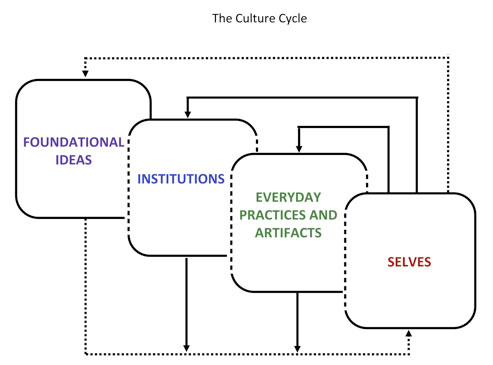
Hazel Markus Diagram of the 4Is ~ Ideas, Institutions, Interactions, and Individuals – Image Source: edge.org
Social scientist, Hazel Markus, from Stanford University, began her talk with a story about her 10-year-old daughter wanting to play the cello and, subsequently, quitting the cello. The story concluded with the mother of a her daughter’s classmate calling Markus to ask why she let her daughter make the choice versus pushing her to continue. I believe the other mother was Asian. I think you know where this is going. Battle Hymn of the Tiger Mother sound familiar? Our models of self are defined heavily by our culture and history (Beau Lotto ala carte). Markus used the term, standard issue human, and our human components fall into the 4Is – Ideas, Institution, Interaction, and Individuals. Essentially, we think, feel, and act in accordance to our culture based on these 4Is. She stipulated two models of the self, which I found really interesting, 1) Independent and 2) Interdependent. Independent is defined as an individual, unique, influencing, free, and equal to others while interdependent means relational, hierarchical, and connected to others. Markus referenced the “mom-choice condition” where interdependent children are more motivated by what their parent provides to the child for intellectual (rather functional) use. Thinking back on how my mother raised me, I think it’s absolutely fitting to say she was an interdependent with a strong desire to raise an independent. That made for some interesting times growing up.
To round out the talk on the individual within society, Paul Ekman, UCSF professor emeritus, presented with no PowerPoint, which was extremely memorable! He definitely didn’t need them. As a behavioral science theorist and practitioner, he discussed how feelings are dependent on our constructive nature. We also describe our experiences through language but language has its limitations. The problem with language is based on the idea that words could not even begin to fully describe our emotional experiences. The very word happiness (alone) is misleading, he claims. It doesn’t point to all of these other factors that go into what we can actually describe as (true) happiness. (Side note: I’m a huge fan of Ludwig Wittgenstein who believed humans were linguistic animals. I mean, it is one of the things that separates us from other species. In any case, I was excited about Ekman’s talk). Ekman also specializes in facial coding and recognition. Imagine the show Lie to Me. Well, that’s what Ekman specializes in. His studies on deception are fascinating. He claims it’s human nature to WANT to be misled because, “We are bias to see threats that aren’t there”. Aside from Ekman’s research and years of wisdom, he was one of my favorite presenters from the conference. I guess I enjoyed what he had to say because it had to do with the fact that I’ve been ‘at a loss for words’, or lied (Sorry, Mom! Unfortunately for me, I’m a horrible liar!), or engaged in lying on behalf of a friend (I’m so happy high school days are over).
Personally, one of my favorite contemplatives (ever!)
IV. Conscious Experience
The last section of the day covered the Conscious Experience. Tami Simon was the facilitator for this last dialogue, which was between Gelek Rimpoche (Buddhist monk), Richie Davidson (Neuroscientist and Researcher), and Jon Kabat-Zinn (Scientist).
Being a human being, to Rimpoche, is creating a future with compassion and love. Rimpoche seemed hopeful the discussions on neurobiology and science suggest having empathy is intrinsic to human nature. Although a simple message, many Buddhist tenets, when incorporated in daily life can have a dramatic effect on the way we care for ourselves and others. Richie Davidson touched upon contemplative practice as “…a vehicle for becoming aware of our emotional life”. Familiarizing ourselves with our own mind and being conscious of our experience is imperative. One of my favorite quotes from the day was when Davidson stated, “An honest scientist needs to relish uncertainty”. Uncertainty is a part of knowing the self. Everyone WANTS to know and be connected to the world (all the time) and this is just not possible. Jon Kabat-Zinn mentioned the same method of dealing with life. Participating in meditative exercises to know the mind. He reminded us that there are about 100 billion neurons and 100 trillion connections but these cells came from 1 cell!! Trying to get at such a granular and molecular bird’s or bug’s eye view of ourselves can be very challenging though. Strangely, even though writing about the conscious experience was the easiest, it’s probably also the most difficult to understand. I’ve meditated on-and-off for the past few years and the times I do, it truly brings me back into the moment. However, I see other forms of meditation that don’t consist of sitting on a cushion (i.e., walking through a gallery or a museum, preferably when it’s extremely quiet) and looking around at what as been created). LIFE is a meditation but I guess it really matters the way in which one lives it and how they take their collective experiences and transform them into an opportunity to learn and ruminate. How many people actually do that? Sitting at the conference, all of those individuals there, that’s such a small fraction of the world! Overall, it was nice but at the end, I left wanting more…(Perhaps, this is exactly what the presenters wanted).
Suggestions for the next Being Human 2012 Conference
The conference can easily be two days
Incorporate more discussions that involve the arts (visual and performing)
A larger venue
A place for the media folks (press and bloggers) to connect with each other!
Have presenters answer questions from posed on the live Twitter feed
This write-up is LONG overdue! Caught up with other writing assignments and, well, being human (probably half the time being a human doing). In any case, here’s my lengthy piece on the conference. I had to break up the posts into two parts. Here’s the first part of my reflections along with an introduction.
Comments, constructive feedback, and/or challenging questions are more than welcome! Enjoy!!
Introduction
As a child, I constantly wondered, “Who am I?”. My father was 60 years old and my mother was 26 years old when I was born. Growing up, the retired military man was the stay-at-home parent. He constantly played his big band music on AM radio and, often times, strummed his guitar. His traditional and gender specific beliefs accompanied by strict rules were challenging to abide by. On the opposite end of the spectrum, my mother was progressive, young, vibrant, and provided all the essential talks (i.e., issues about sexuality, dating, friendships, etc.). My mother let me dress in button ups and men’s neckties and allowed me to play around with gender representation in my pre-pubescent and early teen years (she let me wear overalls and baggy jeans). Ironically, my father let me listen to rap music and the Mary Jane girls while my mother refused to buy me McDonald’s, made me read the dictionary, and listen to classical music.
Colorful upbringing? Absolutely!
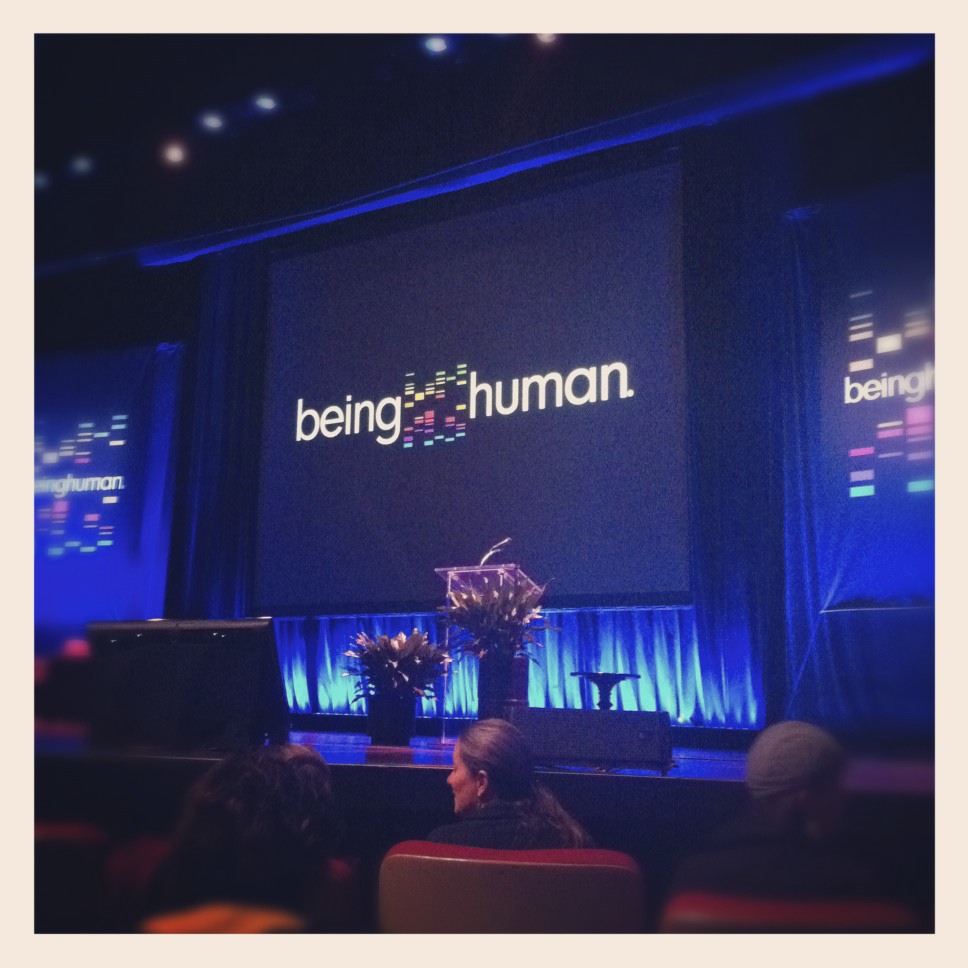
After attending the Being Human 2012 conference, my fascination with the human brain, mind, and body expanded and brought me back to these childhood memories. Naturally, I thought about the past few years and how much has happened! Now, if you weren’t at the conference and would like to view the full programming or a specific presentation, please visit the Being Humanfora.tv channel by clicking here. Trust me, the talks were engaging, enriching, and are worth your time. Most importantly, you are more than welcome to return to this particular virtual space to take part in a dialogue with me, which I would LOVE!
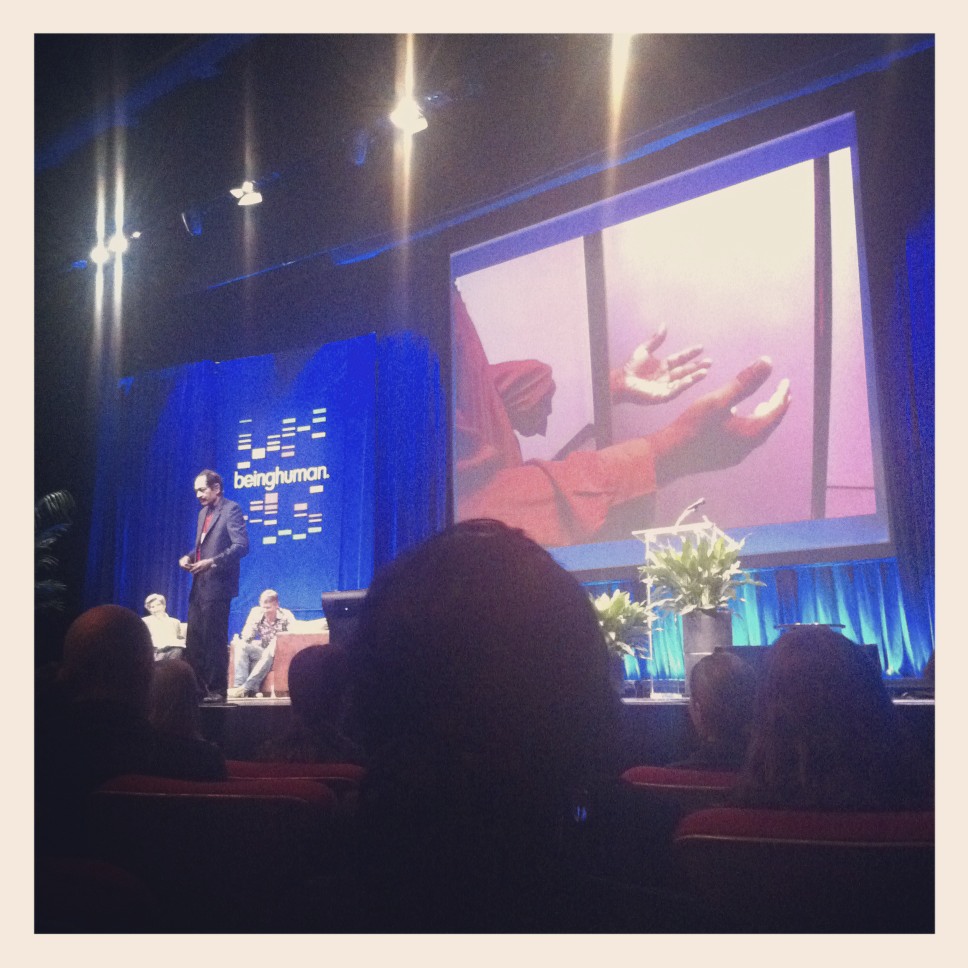
VS Ramachandran, Phd ~ Center for the Brain and Cognition at the UC San Diego
Please note, I organized the post sections per the order of presentations! 🙂
I. Sensation + Perception
Everyday, we use our senses to tell us something about our environment. From feeling the temperature of a cold room that may lead to turning up the thermostat or perceiving colors in a book, our eyes and sense of touch certainly work in concert with our brain to help us navigate the familiar as well as the unfamiliar.
Neuroscientist and artist, Beau Lotto, started with an entertaining and participatory talk on perception. As a performance artist, he offered a fun look into how our brains perceive visual information and how our perceptions easily fall prey to illusions. Throughout his talk, he made clear that, “Context is everything”. Since our perceptions change due to context, he asserts, “All information IS meaningless”. When we get feedback from our experiences, we see the world through that particular experience, and the world changes. Now, here’s the throwback statement to my undergrad philosophy reading of Immanuel Kant, Lotto stated something along these lines, “…the brain finds relationships through engagement with the world and develops meaning”. Gestalt psychology came to mind as while listening to him speak but that’s an entirely different bag of neuropsychology goodies. Lotto also claimed, “the brain continually redefines reality and history of interactions”. Essentially, we get to select our delusion (or illusion) and, according to his definition, “The brain is a representation of its history”. It’s good to know that my long list of to-dos for the week is, well, pretty non-existent. Then again, it depends on how I perceive this list and what I do with the information, right? According to Lotto, my manager may see things differently! 😉 Visit Beau Lotto’s site here.
Friendly Exchange on the Social Network ~ Yes, Sarah gave me full permission to use this image!
Soon after, popular neuroscientist, VS Ramachandran, shared thoughts on body and brain interactions. As you can see from the screen capture above, I was tweeting throughout the event. A scientist friend was equally engaged with Ramachandran’s work! For those of you not familiar with his work, he has done significant research on the “Phantom limb”. Through brain imaging and behavioral neurology, Ramachandran’s research points to the idea that the human brain has the full capacity to see itself as (physically) whole despite circumstance (i.e., being an amputee). Essentially, an amputee’s ability to physically feel, sense, and perceive their absent limb. Although an arm is not physically seen, the brain doesn’t know that the arm is gone. It continues to receive signals. Ramachandran compares this to a virtual reality system. Mirror Visual Feedback (MVF) Virtual Reality (Complex Regional Syndrome Type II) to be exact. To learn more about Ramachandran’s work, click here.
David Eagleman, Phd ~ Neuroscientist and Professor of Neuroscience and Psychiatry at Baylor College of Medicine
II. Mental + Self Representations & Decision Making
Laurie Santos, Comparative Psychologist, presented on irrationality, decision-making, and human error. Her presentation , The Evolution of Irrationality: What Monkeys Tell us about Being Human covered two topics, 1) Understanding the bad parts of being human and 2) irrationality. Now, it’s pretty difficult to monitor decision-making processes of humans but she wondered if Capuchin monkeys could develop their own system and technology of commerce. She was pleasantly surprised to learn the species knew more than she expected. One of the fascinating aspects of her research and presentation involved reminding the audience that even in the face of consequences, we STILL make errors. Personally, I think of looking into a fridge multiple times KNOWING very well nothing has changed and some slice of chocolate cake is not going to magically appear (yes, I have looked into a fridge multiple times) is irrational. I’ll be the first to admit it. It is human to repeat actions and gestures to see if there is a different result. Santos’s presentation reminded me of Gambler’s Fallacy. During her talk, she discussed how economic biases and systems of errors play a tremendous role on our ability to make decisions. Specifically, there are two biases humans grapple with, which are 1) Reference point bias: we think along the status quo and 2) loss aversion: which entails taking on more risk. She found monkeys, like humans, typically play it safe. Although decision-making is not necessarily what people may think of when asked the question, “What does it mean to be human?”, decision-making is integral to our development. We make decisions everyday of our lives – some minor (Blueberry muffin or oatmeal) to major (deciding to have major surgery and dealing with the odds and consequences of a life altering decision). Yet, it is our decisions, our choices, that dictate what happens.
After listening to research around decision-making, philosopher, Thomas Metzinger, discussed the idea of being selfless or self representation. He started his talk by sharing two experiences: 1) when he started his doctoral program, he found many people did not believe in the idea of the soul and 2) Metzinger’s out-of-body-experience (OBE) after a meditation retreat. Personally, it’s great when people share personal experiences verus pontificating on some point based on their research! It was great because a lot of the intro meshed with the two philosophical concepts he presented. First, the Self-Model, which is the idea that an individual’s thoughts and emotions, phenomenologically entail some global form of consciousness. He referenced Spinoza’s idea that the Soul is the body that develops. The second concept was transparency. Essentially, transparency entails no access to the construction process. A person is not privy to how the soul’s construction because the body develops in tandem with the soul. Bottom line: Self-Model + Transparency = Selfhood. In the Q&A, Metzinger expressed wanting a refined culture of “effortless introspection” and non-judgement. Although I wholeheartedly believe in Metzinger’s idea, you would need a lot of people that actually care to know what introspection means.
Well known, Neurobiologist, David Eagleman started off with a question about “How do we know everything that happens in the brain?” He brought up a neuroscience joke about the tennis serve that went a little something like this, “If you want to muck up a tennis game, ask your opponent to show you their tennis serve (basically, they can’t! It’s difficult to mimic exactly what action takes place). That particular example makes a lot of sense and is reminiscent of the times when someone has said, “Wow, great shot or nice lap around the rink (I’m referring to skating) and out of nowhere, I mess up royally on my next shot or fall from showboating! In essence, it is in our nature for over analysis to kick into warp speed and alter what comes naturally to us. I enjoyed Eagleman’s metaphor of the brain being similar to parliament or a governing body with a multitude of experiences and perspectives. If there is a conflict in your neurobiology, this effects decision-making yet it is difficult to truly know what is in someone’s brain, literally. When the brain changes so do you. He brought up famous cases in history (i.e., Phineas Gage, Charles Whitman, etc.) that all point to us being our biology! Another fascinating aspect of his presentation dealt with the legal assumptions we collectively take on. We either base our decisions off of being 1) practical reasoners or the belief that we are equipped with 2) brains that have equal capacity (which simply isn’t true). Eagleton asserts neuroscience suggests these are poor assumptions to take on!! His take-home message: Know Thyselves (meaning, get to know the multifaceted make up for your neurobiology, personality, and psychology). Need to get rid of the illusion that you can completely make the distinctions that are happening neurologically. Lastly, make yourself an avid practitioner of exercising in the “pre-frontal gym” to constantly develop.
Watch for Part II…I actually bring art into the discussion. Thanks for reading (especially if you’ve read all of this!) 😀
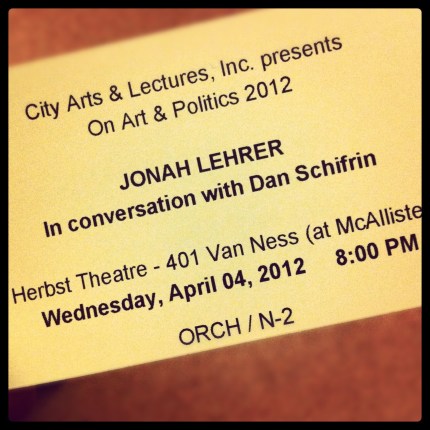
The other night, I went to Herbst Theatre to check out the City Arts & Lectures: On Art & Politics series ~ Jonah Lehrer in conversation with Dan Schifrin. Aside from learning Jonah Lehrer is quite good-looking in person (he really does look like his photographs!), he told some really engaging stories about creativity in the post modern world. Here are some of the more interesting aspects of the evening (and based on his current book, Imagine: How Creativity Works):
Brainstorming is bunk! – I agree. I love the idea of good debate where folks challenge one another!
Alpha Waves help modulate the mind – Keeping the balance between the two hemispheres
Swings of mental state – Being in a happy mood, we are able to solve puzzles BUT when sad/depressed, we tend to solve problems. It is definitely important to accept that there are times we’re going to feel sad and depressed. Quite Zen and Buddhist, I like it!
Below are some of the interesting questions Lehrer answered during the Q&A session followed by my interpretation and 2 cents on his answer.
Does the political process get in the way of creativity?
Ha ha. I loved that someone asked this question. I know when I think of creativity in politics, my view is quite biased and slanted. If there is any creativity, it probably has a lot to do with skewing perspectives and viewpoints and playing around with statistics to sway the public. Lehrer provided a much more robust answer, most definitely. He mentioned looking at “ages of excess genius” (i.e., Elizabethan England, Athens, etc.). He noted a primary theme during these times in history was this vast expansion of human capital through education. The 21st century genius is one of physicality. We reward this physical genius and encourage it while not encouraging other facets of human growth and development. Lehrer expressed a profound wish to see that type of investment and transfer of skills to the arts and sciences! YES! AGREED!!!
Lehrer addressed a question that involved his perceptions of the two traditions of therapy, 1) Psychoanalytic vs. 2) Cognitive Behavioral Therapy?
I liked that he answered the question stating that it wholly depends on the state of the patient and their need to know and wish to have or meet a specific stream of associations. Although many HMOs want people to go to psychotherapy, he believes that individuals have different needs. In regard to creativity and the different types of therapies, it all goes back to the patient, which is something I agree with. There definitely are instances where a specific type of personality requires an alternative therapeutic method. My take on his answer: the therapist would must engage in a creative approach when it comes to mental health and care of the patient.
Related to the question above, an audience member asked about anti-depressants and its impact on creativity?
Lehrer was honest and said he didn’t really know how to answer this specific question. However, he provided the insight that sadness is also a type of thinking! He reminded us that our culture has a tendency to ‘valorize positive emotions’ but there is value in sadness. Going on, he remarked that Aristotle and the Romantics (sounds like a great band name actually!) appreciated sadness and embraced it. When he said this, it totally reminded me of the Buddhist concept of 1000 Joys and 1000 Sorrows.
How has your creative process change after writing these three books?
He was rather enthusiastic in sharing that after writing these books, he is more likely to follow his gut. Whether it’s going for a hike, taking a break, “wasting” some time, it’s necessary to disconnect and not push it. He also noted that people with diverse social networks experience more creativity and innovation in their processes. One of my FAVORITE things he said, which is something I think I do pretty well ~ ask questions! Engaging in dialogue is IMPORTANT. THANK YOU JONAH LEHRER!!!
How do you feel about Information Overload?
One of my favorites from the evening: Struggle to daydream! He made mention of ‘punctuated daydreaming and plugging back into the network’ and how real world connections are STILL important to our growth and development as people, a society, and culture. Personally, this is what I’ve ALWAYS loved about the arts. Art ought to be experienced and discussed and although there are a variety of ways to experience art and look at it online (i.e., Google Art Project, s[edition], kapsul, etc.], people need to make an earnest effort at disconnecting in order to connect in the real (physical) world.
* * * *
Now, as much as I enjoyed the evening and absolutely agreed with diversifying one’s network (this is pretty much common sense if you want to make it in the world, especially in this age, you NEED to connect and collaborate) and appreciated his examples on how different levels of creativity can influence and impact cognitive processes, I noticed something. I shouldn’t have been surprised by this but when the house lights were turned on for the Q&A portion of the talk, I looked around and the majority of people were white. I BARELY see people of color at events like this. I’m hoping we can instill the need for narratives and experiences across cultures and people to younger generations.













 Dorothy R. Santos, Ph.D.